Monday, June 1, 2015

Review
Favorite Daughter, Part One
by Paula Margulies
 
I was not entirely satisfied with Paula Margulies’s Favorite Daughter, Part One.  Certain aspects of the novel informed and entertained me.  Other aspects disappointed.
 
I commend the author for her selection of subject matter.  Historians know very little about Algonquian tribes that lived near the Atlantic coastal waters in the late 16th and early 17th Centuries.  Their knowledge is limited to what English explorers and colonial leaders chose to report.  The story about Pocahontas and John Smith that most people are familiar with – for instance, Pocahontas throwing her body over Smith to prevent his execution -- is Smith’s version of what happened.  Historians question Smith’s veracity.  The author has written a somewhat different account.
 
I compliment her additionally for detail she provides about Virginia Algonquian life. 
 
I was interested in the food the Algonquian Americans ate and how it was prepared.  The way the women carried water (in large, hollowed out gourds and in deer bladders) and how at least the elite villagers dried their hands (on downy bird feathers) intrigued me.  The author’s detail about ceremonial dances was informative.  For example, a successful group hunt was replicated afterward in the village by its women, representing the hunters, surrounding the men, dressed to represent the hunted.  Closing upon the increasingly clustered “animals,” the “hunters” sang songs that urged the prey to surrender.
 
How the Algonquians identified objects entirely foreign to them and how they identified the passage of time was also intriguing.  The Atlantic Ocean was called “the Great Waters.”  An English sailing ship was a “swan canoe.”  A musket was a “fire-stick.”  A year’s passing was called a change of leaves.  A month was a new full moon.
 
I appreciated the author’s portrayal of Powhatan.  He is not the stereotypical fierce warrior, intimidator, and intractable enemy of the Jamestown settlement as he is often depicted.  Fairly early in the novel the author has Powhatan say this to Pocahontas.
 
“In my sixty years, I’ve seen our people flee, to lie in the cold woods, feeding upon nothing but acorns and roots, with no rest, little food, and poor sleep,” he says.  “We’ve prevailed, but we’ve lost many, and still the outsiders return.  If our people are to survive, we must learn to live with the intruders.  It’s only through friendship and trust that we bring safety to the people.”
 
Finally, the author’s narration of events leading to John Smith’s capture and his averted execution did engage me.  Part of the appeal was the natives’ lack of knowledge about the Tassantassuk (the outsiders, i.e. the English).  How Powhatan chose to engage the English, recognizing that every option had its risks, encouraged me eager to continue reading.
 
Much as I liked certain aspects of the novel, I was not satisfied with the entirety of it.
 
First, although the author’s narration is professional enough throughout, in no specific place did I consider it exceptional.  I did like many of the similes Pocahontas uses because she relates sensory impressions to facts of nature.
 
            “still as stones at the bottom of a river”
            “limbs twisted like the oak tree”
            “her arms and legs brown and smooth like the skin of a water snake”
            “his hair hangs to his shoulders like wet vines”
 
I felt, however, that her presentation of sensory description in scenes involving dialogue could occasionally have been more precise, more what the senses actually experience than what the mind easily generalizes.  The narration in the example below is a good example.  It is adequate, not exceptional.
 
The urge to run after him is strong; I take a step in his direction and then stop when I see Winganuske [her father’s newest wife] at the door of my father’s house.
 
“What’s the matter, Pocahontas?” she murmurs.  “Is your future husband leaving you already?”  The smile on her face does not match the tone of her words.
 
“He is not my husband,” I mutter, the skin on my cheeks burning.
 
“And whose fault is that?” she asks.
 
“You don’t know anything about me and Kocoum,” I say, my lips quivering and my voice shaking in my throat.  “Why can’t you leave us alone?”
 
Second, I am not a fan of first person narration.  Pocahontas tells us her thoughts, feelings, understandings, and actions.  At the beginning of the novel she is eleven-years-old.  Her primary conflict, once we get past Smith’s averted execution, is her difficulty in making a life-changing choice.  Should she marry her handsome suitor with whom she has had sex and thereafter immerse herself entirely in the ways of her culture or pursue her remarkable opportunity (her friendship with Smith) to grow beyond the limitations of her culture by learning what the strange, intriguing Englishmen could teach her?  It is a worthy conflict around which an engrossing historical novel could be constructed, but I felt the author fell short of accomplishing that.  (Maybe her forthcoming second installment -- Part Two -- will succeed)  Instead, we read repeated questioning of whom she really loves, the suitor or Smith.  The novel ends without any progress being made toward resolving the conflict.  To pad content, the author invents other conflicts: her father’s newest wife clearly dislikes her; her best friend disappears after Powhatan chooses the girl to sleep with Smith, a native custom afforded guests.  After Smith is released by Powhatan to return to Jamestown, I lost interest in the novel.  The only question that I wanted answered was how much more would Powhatan tolerate being used by the English before he accepted the fact that he could not live next to them in peace.  Utilizing third person points of view that focuses on Powhatan and Smith as well as Pocahontas would have dramatized better the second half of the novel.


Saturday, May 23, 2015

Thomas Nelson -- Independence
 
A stout man of 38 years sat waiting to affix his signature to a copy of the newly formed and approved Declaration of Independence.  Richard Henry Lee, a delegate from Virginia, had moved on June 7, 1776, that “these United Colonies are, and of right ought to be, free and independent States …” The Second Continental Congress’s Committee of the Whole had discussed Lee’s motion the following day and Monday, June 10, before deciding to postpone final consideration until July 1.  The middle colonies and South Carolina had not been ready to sanction the final break; but -- the Committee had believed -- given time, they could be persuaded.  A committee, which included Thomas Jefferson, Benjamin Franklin, and John Adams, had consequently been formed to write a declaration of independence.  On July 2 a resolution for independence had been adopted.  On July 4 twelve colonies had approved Jefferson’s Declaration of Independence. The New York delegation had chosen not to vote.  On July 15 New York had accepted the Declaration and Congress had ordered that it be engrossed on parchment and signed by the members. 
 
Thomas Nelson was one of the famous Virginia delegation that had won so much praise from the pen of John Adams of Massachusetts.  Washington, Henry, Pendleton, and Bland were all missing from that first group of delegates who had come north in the spring of 1775.  Nelson was one of four new men who had taken their places.  Adams described him “as a fat men … He is a speaker, and alert and lively for his weight.”  Pennsylvania delegate Benjamin Rush provided more information.  Rush wrote that Nelson is “a respectable country gentleman, with excellent dispositions in public and private.  He was educated in England.  He informed me that he was the only person out of nine or ten Virginians that were sent with him to England for education that had taken part in the American Revolution.  The rest were all Tories” (McGee 224, 226).
 
Before affixing his signature Nelson very likely recalled his position on independence during the previous twelve months. 
 
He had decided early that hostilities had progressed too far and that a final stand would have to be taken.  There remained, however, opposition to independence in Congress, especially from New York, Pennsylvania, and Maryland.  “But events were pushing the colonies in the direction of independence whether all of them liked it or not.  In Virginia the militia commanded by William Woodford defeated a British force under [former Governor] Dunmore at Great Bridge, forcing the noble lord to abandon Norfolk; in Canada the combined American forces under Benedict Arnold and Richard Montgomery were repulsed before Quebec on December 31 [1775].  These occurrences, coupled with a royal proclamation of December 23 closing the colonies to all commerce as of March 1, 1776, made the breach between England and the colonies almost irreparable” (Evans 54).  On January 22 Nelson had written his friend in Virginia, John Page, how he wished he knew “the sentiments of our people upon the grand points of confederation and foreign alliance, or, in other words, of independence … We cannot expect to form a connexxion with any foreign power, as long as we have a womanish hankering after Great Britain; and to be sure, there is not in nature a greater absurdity, than to suppose we can have any affection for a people who are carrying on the most savage war against us” (Sanderson 51).
 
Soon afterward, Thomas Paine’s famous Common Sense had been published.  Nelson had sent a copy home to his friend, Thomas Jefferson, at Monticello.  Here was a stirring piece of work that Nelson must have embraced heartily.  No doubt he had hoped it would convince many in the states of the folly of striving for peaceful conciliation with Great Britain.  There were still many men in the Congress who needed to alter their thinking.  In February Nelson had written Page an intense letter that expressed his frustration.
 
Independence, confederation, and foreign alliance are as formidable to some of the Congress, I fear a majority, as an apparition to a weak, enervated woman.  Would you think that we have some among us, who still expect honourable proposals from the administration?  By heavens, I am an infidel in politics, for I do not believe, were you to bet a thousand pounds per scruple for honour at the court of Britain, that you would get as many as would amount to an ounce.  If terms should be proposed, they will savour so much of despotism, that America cannot accept them.  We are now carrying on a war and no war.  They seize our property wherever they find it, either by land or sea; and we hesitate to retaliate, because we have a few friends in England who have hips.  Away with such squeamishness, say I” (Sanderson 52-53).
 
Upon returning to Virginia in March to spend time with his family and to attend to business matters, he had discovered that a majority of the colony’s population favored independence.  The Virginia Gazette had “expressed the sentiment of many when, soon after his arrival, it declared: ”If we cannot enjoy the privileges of Englishmen when connected with them, let us instantly break off to them” (Evans 55).
 
On May 6, one hundred twenty-eight delegates had convened in Williamsburg to conduct the final business of the soon to be replaced House of Burgesses.  The Convention had elected Edmund Pendleton to be its president.  Nelson had been appointed to the important Committee on Privileges and Elections.  Jefferson had urged Nelson to raise in committee the issue of independence.  He had done so in his numerous communications with other delegates.  To one delegate (not identified) he had written “having weighed the arguments on both sides, I am clearly of the opinion that we must, as we value the liberties of America, or even her existence, without a moment’s delay, declare independence.”  There was no need to determine the opinions of France and Spain.  France would benefit from the separation.  Fear in the minds of some that England would give territory to either country on the condition that it not support the colonies was “chimerical.”  Nelson declared that the military “would abandon the colors if independence were not declared.  … the spirit of the people (except a very few in these lower parts, whose little blood has been sucked out by mosquitoes), cry out for this declaration” (Evans 56).
 
Quite surprisingly, Patrick Henry had been hesitant.   He had feared precisely what Nelson had dismissed – “that England would call on some European ally with the promise of a part of the colonies as a reward for helping to subdue them.”  Henry had believed that an alliance with France or Spain had to be affected before separation could be declared.  When he had recognized that “he would lose much of his support unless he lead the movement [for immediate independence], he took the initiative, allies or no allies” (Evans 57).  Consequently, he had devised a plan.  He would persuade Nelson to introduce a motion for independence and Henry would then work for its acceptance.  The plan had been effected.
 
Edmund Randolph had written later that Nelson “affected nothing of oratory, except what ardent feelings might inspire, and characteristic of himself he had no fears of his own with which to temporize …” (McGee 226-227). “He passed over the probabilities of foreign aid, stepped lightly on the difficulties of procuring military stores and the inexperience of officers and soldiers, but pressed a declaration of independence upon what, with him, were incontrovertible grounds; that we were oppressed; had humbly supplicated a redress of grievances, which had been refused with insult; and to return from battle against the sovereign with the cordiality of subjects was absurd” (Evans 57).
 
On May 17 Nelson had left for Philadelphia with the Virginia delegation carrying the resolutions that the Virginia convention had agreed upon., to wit that Congress “‘declare the United colonies free and independence states, absolved from all allegiance to, or dependence upon, the crown or parliament of Great Britain’” (Evans 58). 
 
Now, August 2, Thomas Nelson affixed his signature to the official document.
 
Nelson had much to lose financially.  He had written to a Virginia colleague three months earlier that “no man on the continent will sacrifice more than myself by separation” (Evans 56).  Yet quite early he had stood forcefully for independence.  He, like every delegate to the Continental Congress, also knew the personal danger of this position.  What real chance did a band of disjointed states, challenging the immense power of Great Britain, have of prevailing?  It behooved Nelson to work assiduously to achieve that outcome.
 
Works cited:
 
Evans, Emory G.  Thomas Nelson of Yorktown: Revolutionary Virginian.  The University Press of Virginia, Charlottesville, Virginia, 1975.  Print. 
 
McGee, Dorothy Horton.  Famous Signers of the Declaration.  New York: Dodd, Mead & Company, 1955.  Print.
 
John Sanderson, Biography of the Signers of the Declaration of Independence, Second edition. Philadelphia: William Brown and Charles Peters, 1828.  V.  Print.   

Thursday, May 7, 2015

Writing "Alsoomse and Wanchese" -- Original Sources, the Weroance


First, a few factual statements.

Algonquian-speaking tribal groups in the 16th Century ranged from coastal North Carolina to Canada and from the Atlantic Ocean to the Great Lakes.  English explorers/colonizers encountered them at Roanoke in 1584, Jamestown in 1607, and Plymouth in 1620.  Algonquians in North Carolina inhabited land that extended northward from the Pamlico River to the northern shore of Albemarle Sound and westward from the Outer Banks to the banks of the Chowan River.  Farther south and west lived Iroquois tribal groups.

“Tribal boundaries cannot be established beyond doubt. Allied but independent groups were sometimes regarded as single tribes by the European observers. Thus, the Roanoke, Croatoan, and Secotan tribes are frequently referred to as one tribe … Uncertainty about locations of villages makes assignments to tribes difficult. This applies particularly to the Weapemeoc, Chawanoke, and Moratuc, and to the Algonquian boundary with their [hostile] Iroquoian neighbors.There is evidence for precontact hostilities between the Secotans and their allies, and the Neusioks and Pomouiks. The Chawanokes were generally on good terms with Virginia Algonquian but they -- probably like most Algonquian groups of the region--were frequently at war with the [Iroquois] Tuscaroras” (Feest 1).

The Carolina Algonquians called the land and waters they inhabited Ossomocomuck.  Their villages can be found on this map.  http://homepages.rootsweb.ancestry.com/~jmack/algonqin/feest1.htm

Original Sources

Almost all that we know about the coastal North Carolina Algonquian people comes from reports written by five Englishmen.

Arthur Barlowe, the captain of one of two ships Walter Raleigh sent to North America in 1584, wrote this report:
The voyage to Pamlico Sound, the visits to the villages of Pomeiooc, Aquascogooc, and Secotan and the delayed return to Roanoke in 1585 was described by Richard Grenville, commander of the fleet of ships sent by Raleigh to establish a colony.  Grenville’s account may be read here:
Ralph Lane, the governor of the colony begun in 1585 and abandoned in 1586, wrote the following:
Thomas Harriot and John White were members of Captains Arthur Barlowe and Philip Amadas’s contact with Roanoke Algonquians in 1584.  More importantly, they were major players in Raleigh’s attempt to found a colony at Roanoke under Governor’s Lane’s authority (1585-1586).  Most of what we know about the Carolina Algonquians is due to these two men’s efforts.  A young man, perhaps 24 years old in 1584, Harriot would become a leading scientist of his time.  Studying the Algonquian people like an anthropologist, Harriot learned much of their language and much about their culture, behavior, and religious beliefs.  John White was a skilled artist.  His water color paintings provide us invaluable visual representation.  You may read Harriot’s report to Raleigh here:
Governor Ralph Lane and his settlers/soldiers returned to England in 1586 on ships commanded by Sir Walter Drake.  Richard Grenville, assigned to resupply the colony that year, arrived at Roanoke after the colony had left.  Here is what Grenville wrote:
In 1587 Raleigh authorized a second attempt to establish a colony in North America.  He appointed John White to be its governor.  Here is what White wrote about this attempt.

White returned to Roanoke in 1590, hoping to find the people he had been forced to leave in 1587.  He wrote the following:

The Weroance

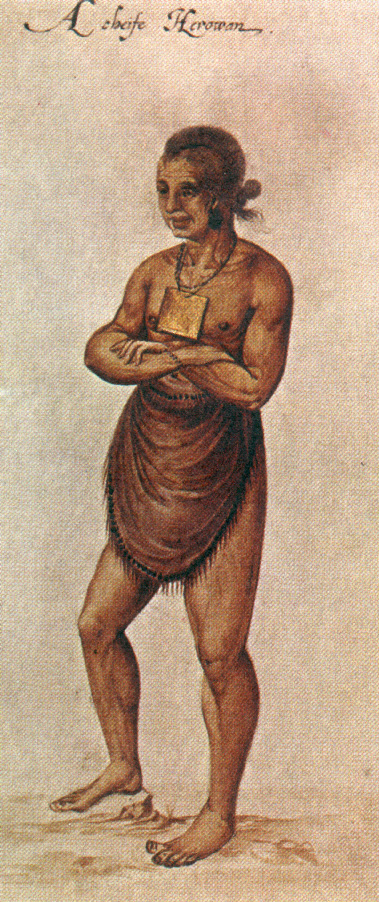
The leader of Roanoke, Dasemunkepeuc, and possibly Croatoan, Pomeiooc, Aquascogooc, and Secotan and the weroance that Governor Lane eventually killed called himself, initially, Wingina.  He was a man of middle age, which meant – even though Thomas Harriot found the Indian population to be remarkably healthy – that he was probably in his mid to late thirties.  White’s painting shows him to be muscular, with large eyes and full lips.  Not typical of his elite class, he is understated in decoration.  http://myweb.rollins.edu/jsiry/JohnWhiteChieftain1580s.jpg

According to the historian Michael Leroy Oberg, Wingina “spent most of his time at the village of Dasemunkepeuc … Here there was access to the great variety of resources in the area, including fertile soil for maize agriculture.  Wingina and his people could have moved easily back and forth from Dasemunkepeuc to the village on the northern shore of Roanoke Island.    It is unlikely that the island’s thin soil could have supported a large population, and the majority of Wingina’s people must have spent most of their time across the sound on the mainland.  Wingina’s followers also interacted closely with Indians” (Oberg 6, 8) from Croatoan suggesting that the three villages were unified under Wingina’s authority.

Oberg explains well the role of a weroance.  “Wingina could not command completely, nor could he rule alone.  English comparisons of the powers of a weroance with those of a king are misleading.    Linguists have interpreted the word to mean ‘he is rich,’ or ‘he is of influence,’ or ‘he is wise.’  Other weroances limited or influenced Wingina’s actions, and he relied as well on the advice of high ranking counselors who had earned their status through display of bravery or heroism.  Priests and ‘conjurors’ also provided counsel that he could not ignore” (Oberg 18).

A weroance was expected to preserve balance and order.  In return, his followers paid him tribute.  Weroances and their advisors were considered an elite class to whom followers were required to show great deference.  According to Thomas Harriot, those who committed offenses against other followers were punished harshly: forfeiture of property, beating, banishment, death.  By inflicting such punishment, a weroance sought to restore peace and balance in the community.  Those who were dissatisfied with a weroance’s performance could always quit the community.

A weroance was expected to protect his followers from belligerent communities not under his authority.  He was expected to lead his followers in battle. 

He was expected to secure trade agreements and allies.  Overseeing the exchange of trading goods, he was “the conduit through which items from outside flowed into and were diffused throughout the community.  The success of the weroance as a leader was predicated at least in part on his ability to secure the objects his people needed and desired.  By establishing and overseeing the system, the weroance created reciprocal bonds connecting his community with others in Ossomocomuck and beyond, a major impediment to conflict” (Oberg 21).

To reiterate, weroances oversaw their followers’ major community concerns: its wars, trade, and diplomacy.  Balance and order was “the critical core of his people’s values.”  He was expected to maintain this balance.  “His followers would stick with him so long as he met the needs of his community and the individuals within it.

“After Ralegh’s colonists arrived, Wingina found it difficult to maintain balance and order within his community.  Consensus became increasingly difficult to find.  A leader whose power rested on the respect of his people and his own ability to persuade, and as well a man curious and honest, he moved cautiously after the newcomers arrived.  He found himself caught between Algonquians who saw the English as potentially useful allies, and others who saw the newcomers as a mortal threat to his people’s way of life” (Oberg 21).


White painted portraits of villagers.


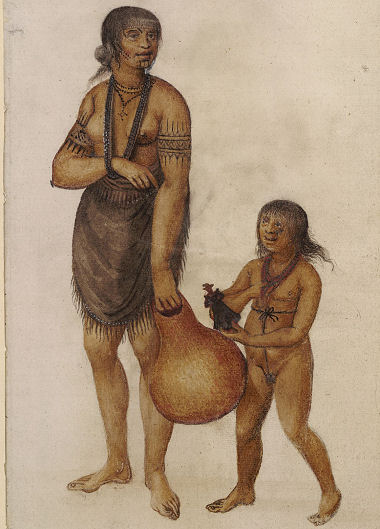
A weroance’s wife and her child, who carries a doll given to her by the English  http://upload.wikimedia.org/wikipedia/commons/e/ed/A_Cheife_Herowans_Wyfe.jpg


Work cited:

Feest, Christian F.  North Carolina Algonquians, Part 1.”  1978.  Rootsweb. http://homepages.rootsweb.ancestry.com/~jmack/algonqin/feest1.htm.  Net.      

Oberg, Michael Leroy. The Head in Edward Nugent’s Hand.  University of Pennsylvania Press, Philadelphia, 2008.  Print.  


Friday, May 1, 2015

Review
"Ethan's Peach Tree"
Stan Jensen


Stan Jensen’s “Ethan’s Peach Tree” was just about all I had hoped it would be.

Set near Atlanta, Georgia, prior to the Presidential election of 1864, during Union General William Sherman’s campaign to capture the city, the fictitious General Nathan Chambers finds his brigade of the Army of the Cumberland located close to a crossroads that Confederate troops must pass through to evade Sherman and create havoc to the north.  Sherman orders Chambers to occupy and hold the crossroads at all cost.  The author narrates a horrendous battle, one brigade and attach units of cavalry and artillery pitted against an entire Confederate corp. 

For Civil War enthusiasts, this is definitely a book to read.  The author clearly knows his stuff: what soldiers ate for breakfast, how they loaded their weapons, how artillery was operated, how surgeons ministered to the wounded, how generals and colonels lead their men, and much more.  This novel exudes authenticity.

Its detail leaves no reader in doubt as to what Civil War savagery wrought.  Here are two examples.

Moans and murmurs blended, screams merged, cries rose and fell, and while all these voices joined together in terrible concert, the blood slowly cooled in the veins of the dead.

Wounded soldiers cried out.

           “Do ya s’pose when I do finally pass, the Lord’ll have my cut-off arm waitin’ fer me in
            heaven?”

“Mama, it that you?”

Offered water, “Don’t want nothin’ but my face back.”

This book is especially instructive to adults (like me) that have not experienced combat.  Its theme of what drives men in wartime to risk sacrificing their lives to kill the enemy is palpably evident.

This novel is not a one-year-in-the-writing, slap-dash, the-story-is-good-enough-so-go-read-it offering.  It is the outcome of thoughtful planning and, I must conclude, considerable revision.  It’s diligence shows in the author’s characterizations; it shows in how he demonstrates his use of researched information; it shows in his careful word selection and phraseology.

We meet all sorts of complex human beings, in all instances but one (in my opinion) entirely believable.  General Nathan Chambers is an excellent example.  He had been raised on an Iowa farm by a father who judges people beyond the boundaries of his land to be deficient in “kindness and goodness … Most people are weak in spirit, they learn nothing from it, only try to pass the hurt on.”  He strives mightily to persuade Nathan not to leave to attend the University.  He tells Nathan that he has worked hard on the farm, taken joy and love from simple things, and has made certain that the family has been safe.  Nathan responds, “I need more than safe.”  He is, in his father’s words, “the thinker, the brilliant one, the scholar, the restless one.” 

In the novel’s first several paragraphs we learn than Nathan is very self-disciplined.  He has weaned himself off the dependency of laudanum to ease the pain of a severely wounded shoulder.  He is able to think clearly amid the chaos of battle.  He is willing to send his soldiers into savage combat.  He exposes himself to a high chance of random death.  Yet he is not devoid of sensitivity and empathy.  He is absolutely committed to defeating an enemy that protects slavery and that continues to necessitate terrible combat and horrendous death.  In battle he is a warrior, angry enough to shout to a regimental colonel: “I want those people dead.  All of the dead!”  In the midst of battle he is capable of making this observation: “No painter could put to canvas what we are now witnessing.  The ranks of disciplined infantry, the flags, the drums, the courage.  My God, what a spectacular evil war is.”

I was especially impressed with the author’s ability to employ sensory imagery.  He is an observer of precise detail that the average person does not perceive during his daily activities.  These details add so much to the realism of what an author wants us to hear, smell, feel, and see.

Rows of tents glowed canvas white in the darkness, some bright with internal candlelight that placed shadows of soldiers on the coarse cloth.

A breeze shook the tent, bulging the canvas inwardly on one side.

Cannons, caissons, and limbers rumbled over the stone bridge, the iron rims of the wheels striking sparks on the stones.

The smoke here was so thick that when an incoming shell streaked through it, the smoke swirled.

The rank odor of singed hair mixed with the hot smell of musket barrels.

Around Dexter, leaves, twigs, and branches fell steadily, clipped by bullets, and he stood firing his revolver at the shadowy enemy beyond their muzzle flashes.

And then there are sensory descriptive scenes.

Devils shrieked across the sky, and all along the Union line the ground shook and the air shivered from the blast of shells.  Trees were blown to splinters.  The earth was augered and plowed by solid shot.  When a section of breastworks heaved up in a geyser of dirt and shattered rail fencing, a soldier went with it, his arms flailing, his legs scissoring.  An officer, wounded in the neck by shrapnel, bled so badly that each time he tried to give orders, blood would fill his mouth and he had to stop and spit it out.


Rawlings picked shrapnel from wounds, tied off arteries, probed with his fingers for bullets, and sawed through the bone of legs, hands, feet, and arms beyond his ability to repair.  These body parts made a bloody mound in the back of a medical wagon pulled up near the live oak.  Doing his work there at the operating table, Rawlings’ feet began to slip and slide.  The ground beneath him was muddy from blood, guts, contents of bowels loosened by agony and death.

Scenes depicting violence are tempered by scenes of tenderness, such as Nathan’s meeting with his sweet-heart prior to his return to war.


She wore a pale rose-colored dress that put white lace at her throat.  When her slender figure quivered, Nathan could see she was struggling to keep control.  He pulled her close, tucked her head under his chin.


Nathan felt her shudder then, and knew the tears had started to fall.  A great tenderness came over him.

            …

Tess looked up at him.  She touched his cheek with her fingertips so gently that he felt his heart tremble.  Her sweet affection weakened him in a way the violence of the battlefield never could.

Family affection is revealed in this scene, the night before Nathan leaves the farm to go to the university.  His brother Ethan does not want him to go.

           
“I’d chop down every apple tree, and even the new peach trees I’m tryin’ ta make grow if you’d just stay here to home.”


“I’d never ask you to give up your orchard, and I’m askin’ you not to ask me to give up my books.”

Nathan wet his fingers on his tongue, then pinched the candle flame out.  He couldn’t bear to look at Ethan’s face anymore, there was too much sparkling and  glittering.  Nathan could hear Ethan lay back down on his bed, and when Ethan spoke, the soft sadness in his voice stabbed at Nathan’s heart.

“It’ll be a strong hurt, you bein’ gone, Brother,” Ethan said.

The only criticism I have to offer is an opinion.  Nathan’s brother Ethan seemed too good-hearted, innocent, and vulnerable; and the plantation owner Juda Ebeneezer was evil incarnate.  It was as though the author was portraying them metaphorically (good versus evil).  I also felt that the events that brought these characters together were contrived.

Nevertheless, I thoroughly enjoyed “Ethan’s Peach Tree.”  Stan Jensen is a talented writer.  I hope he writes another novel.   

Sunday, April 26, 2015

Survey


As a reader of historical fiction, you might be interested in taking a survey conducted by A. K. Todd, blogger of “A Writer of History.”  Here are the blogger’s comments about the survey, which takes no more than 10 minutes to complete. 

Yes, I know some of you will think I'm crazy!

However, the topic of reading is always on my mind and this time, with advice from historical fiction editor and blogger Jenny Quinlan and New York Time best-selling author Beatriz Williams, fellow panel members at the upcoming Historical Novel Society's Denver conference, I'm releasing a 3rd reader survey.
Topics include:

·              preferences regarding famous or fictional characters

·              what makes characters come alive

·              favourite historical novels (yes, this will be complicated)

·              favourite historical fiction authors (let's see how the rankings change this year)

·              effects of social media on the reading experience

Please take the survey and share the link with friends, family, and on as many social media venues as you can - https://www.surveymonkey.com/s/GXRD9B7. The survey will be open until May 14. Many thanks for your help.
A few highlights from prior surveys:

·              HISTORICAL FICTION IS MAINSTREAM: Less than 2% of participants said they rarely or never read historical fiction.

·              GENDER MAKES A DIFFERENCE: Women and men differ significantly in their reading habits and preferences and their views of historical fiction.

·              AGE MAKES A DIFFERENCE: Those under 30 have different preferences for genre and time period and have different patterns of consumption and acquisition.

·              SOCIAL MEDIA IS HAVING AN IMPACT ON READING: Social media and online sites play an increasingly significant role for those choosing, purchasing, and talking about fiction.

·              BOOK BLOGS ARE VERY POPULAR: 1,473 participants listed one, two or three favourite blogs.

·              GEOGRAPHY: Responses to questions such as the use of online tools for recommendations and purchasing and preferred setting for historical fiction varied by geography.

·              PRICING: Sadly, readers are pushing for low prices. For example, 60% want e-books at $5.99 or less and 66% want paperbacks at $10.99 or less.

·              ONLINE BOOK CLUBS ARE GAINING POPULARITY: 21% belong to online clubs while 15% belong to clubs meeting in a physical location

·              VOLUME OF BOOKS READ MAKES A DIFFERENCE: for example, high volume readers have different expectations for book reviews, a higher interest in tracking their books, and higher usage of online tools and social media to augment their reading experience.

A Writer of History has many posts on survey results and insights and you can find summary reports and other popular articles here.
FOR MORE ON READING & WRITING HISTORICAL FICTION follow A WRITER OF HISTORY (using the widget on the left sidebar)

M.K. Tod writes historical fiction and blogs about all aspects of the genre at A Writer of History.
Click this link to take the survey:


Saturday, April 18, 2015

Thomas Nelson -- "Point of No Return"


The First Continental Congress, meeting in September 1774, adopted a non-intercourse agreement similar to that passed by Virginia’s Burgesses.  It called for the establishment of association enforcement committees in the counties of the respective colonies.  The Congress adjourned in October.  It would reconvene in the spring of 1775 because of Britain’s failure to redress their grievances.  Delegates from the counties of Virginia met in Richmond March 20, 1775, to decide upon what policy Virginia should now take in its relations with Great Britain.

At the convention Patrick Henry introduced a resolution that called for the immediate raising of a “well regulated militia” to defend the colony.    The proposed resolution caused a stormy debate.  Many of the moderate members considered the measure premature and dangerous.  Friends in London had sent favorable reports about British intentions.  Henry’s supporters argued that the hope of a favorable change in British policy was delusive.  Virginia must defend herself against whatever dangers might arise.

Richard Henry Lee delivered an eloquent speech in defense of the resolution.  Thomas Nelson then rose, for the first time as a burgess to take an active part in a serious debate.  Edmund Randolph later wrote that Nelson “convulsed the moderate by an ardent exclamation, in which he called God to witness, that if any British troops should be landed within” his county, “he would wait no orders, and would obey none, which should forbid him to summon his militia and repel the invaders at the water edge.”  Randolph recalled that Nelson’s temper, “though it was sanguine, and had been manifested in less scenes of opposition, seemed to be more than ordinarily excited.  His example told those, who were happy in ease and wealth, that to shrink was to be dishonoured” (Sanderson  287-288).  Soon afterward Patrick Henry delivered his famous “give me liberty, or give me death” speech, and the Convention adopted the resolution with a majority of five votes.

The business of the Convention turned to the election of delegates to the Second Continental Congress.  The delegates to the First Congress were reelected.  Falling short, Thomas Jefferson and Thomas Nelson were eighth and ninth in the balloting with 18 and 16 votes respectively.

Governor Dunmore had been watching the activities of these leading men of the colony with great concern.  Now the Richmond Convention delegates had voted to defend the colony.  “Between three and  four o’clock on the morning of April 21, Captain Collins of the armed British schooner Magdalene carried out the governor’s order to remove the entire powder supply of the colony from Williamsburg and place it on board his vessel anchored at Burwell’s Ferry on the James River” (Evans 46).  The seizure caused an immediate and violent reaction throughout the counties.  “One thousand men poured into Fredericksburg, six hundred of them ‘good riflemen’ attired in hunting shirts with tomahawks in their belts.    In Hanover County Patrick Henry was also raising an independent company.  Several patriotic leaders, including Peyton Randolph and George Washington, prevailed upon the Fredericksburg and Albemarle companies to disperse; but Henry, after haranguing his volunteers at Newcastle on May 2, began a march on Williamsburg” (Evans 46). 

Dunmore “sent his wife and children on board an English-bound schooner in the York River, placed cannon in the Palace yard, armed his servants, and asked for a detachment of marines from the man-of-war Fowey, anchored at Yorktown” (Evans 46).  Before daybreak May 4, the Fowey’s Captain Montague and a party of marines roused Thomas Nelson’s aged uncle, Secretary Nelson, from his bed.  Montague warned that if they were molested by any of the townspeople the ship would fire upon the town.  The ultimatum enraged the inhabitants of the surrounding countryside.  Not only was the threat of bombarding the town considered barbaric.  The person who would suffer most from such a bombardment would be Thomas Nelson, who had assumed the responsibility of meeting Henry and his troops (fifteen miles outside Williamsburg) to prevent harm to Dunmore from occurring. 

Although most of the colonists did not know it then, the time for peaceful conciliation with Great Britain had passed.  Anger and the desire for reprisal had dislodged reason.  The contentious events of the past ten years had pushed many colonists to a willingness to bear arms against the soldiers of their mother country.  On April 26, Virginia had received the news that Massachusetts militiamen had fired upon British soldiers in route to Boston from Concord.  Massachusetts’s military governor General Thomas Gage had sent an army of 700 redcoats to Concord to seize stored munitions and gunpowder.  America had reached a point of no return.  She would take a little while yet to realize it.

The crisis of the confiscated powder was settled soon after Montague’s ultimatum.  Several Virginia patriots – Nelson included -- bought the seized gunpowder for 320 pounds.  The ship Fowey remained off Yorktown.  On June 6, Dunmore and his family went aboard, never to set foot in the colony again.

On June 17 British soldiers and Massachusetts militiamen clashed in the Battle of Bunker Hill.

On July 17, the representatives of the counties of Virginia met for the third time during the course of a year.  They passed an ordinance that called for the raising of three regiments of regular troops, to be commanded by a colonel, lieutenant colonel, and major appointed by the general convention.  Patrick Henry, Thomas Nelson, Hugh Mercer, and William Woodford were looked upon as candidates for commander-in-chief of the regiments and colonel of the first regiment.  Henry openly solicited the appointment.  Mercer, born in Scotland, had some degree of military experience.  Nelson acknowledged Mercer’s abilities, said he would not oppose Mercer’s appointment, and declared that he hoped he would not be voted for.  Woodford also supported Mercer.

Seeing that Mercer would be his chief adversary, Henry sought to undermine his qualifications, instilling in the minds of many the thought that Virginia had to be sure loyal patriots commanded her forces.  On the first ballot Mercer received 41 votes, Henry 40, Nelson 8 and Woodford 1.  Henry won a run-off election by a small majority.  Nelson was appointed lieutenant colonel of the second regiment.  Woodford was appointed the major of the third regiment.

The Convention then turned its attention to the election of delegates to the next session of the Second Continental Congress.  Of the seven delegates who had been previously elected, Peyton Randolph, Richard Henry Lee, Benjamin Harrison, Edmund Pendleton, and Richard Bland were considered eligible for another term.  George Washington had been appointed commander-in-chief of the Continental Army.  Patrick Henry, as head of Virginia’s forces, was also considered ineligible.  Pendleton asked to be excused from serving due to ill health.  Three positions were open for new delegates.  They were filled by Thomas Jefferson, Nelson, and George Wythe.  Bland later declined his appointment because of infirmities of age and was replaced by Francis Lightfoot Lee.  After Nelson had been appointed, he declined the command of the second Virginia regiment.  Woodford was appointed his replacement.

One of the most dramatic periods in American history was rapidly approaching.  Thomas Nelson, wealthy merchant and country gentleman, steadfast opponent of British economic and political authoritarianism from its inception, would be an active participant in Virginia’s struggle to attain independence.  “Yet the course he chose to follow was not an easy one.  He felt close to the mother country for many reasons.  He had spent eight years of his life there, and he had many friends and several relatives who still lived in England.  Furthermore, the patriotic cause by no means had the full support of all Americans … Nelson’s wife’s brother, John Randolph Grymes, left Virginia because of his sympathy for the British position.  Both Thomas and Lucy Nelson were related to the Randolphs, and they saw that family torn apart when John Randolph, the attorney general, left Virginia with Dunmore, while his son, Edmund, remained a firm patriot” (Evans 49, 50).  For Nelson, the loss of natural and constitutional rights mattered above all else!

Works Cited:

Evans, Emory G.  Thomas Nelson of Yorktown: Revolutionary Virginian.  Williamsburg, The Colonial Williamsburg Foundation, 1975.  Print.

Sanderson, John.  Biography of the Signers to the Declaration of Independence.  Second Edition. Philadelphia, William Brown and Charles Peters, 1828.  V.  Print.