Tuesday, August 2, 2016

Writing "Alsoomse and Wanchese" -- Getting through the Tunnel
 
I see a light at the end of the tunnel.  The problem now is getting there.
It isn’t helping that I just had a corneal transplant operation on my right eye that makes reading uncomfortable.  That difficulty should pass in three or four weeks.
My main difficulty is linking fictional conflict with historical events.  To reiterate, I took an actual Roanoke Algonquian – Wanchese – whom historians know nothing about prior to 1584, gave him distinctive character traits, placed him in conflict situations, and had him do decisive acts.  I gave him a sister – Alsoomse – a fictitious character, and did to her what I did to Wanchese.  Now I must integrate seamlessly both characters and other fictitious characters into two historical events. 
The first event is the wounding of Wingina, the mamanatowick (king) of six Algonquian villages along and close to the shores of North Carolina’s Pamlico Sound.  Historians are not certain who wounded him and where it happened.  This has allowed me to designate Piemacum, the weroance of Pomeiooc, and his braves as the culprits.  I should not have much difficulty involving Wanchese in this event.  Alsoomse’s left cheekbone was permanently damaged by a blow struck by Piemacum’s primary subordinate – Sunukkuhkau – earlier in the novel.
*** 
She heard the sound of shock, alarm, and Sunukkuhkau’s triumphant hoot. She fought the Pomeuooc brave dragging her. She kicked at his feet; he lifted her, shook her, his hands squeezing to her bones her biceps. Her knees bent, she kicked at his shins, her heels striking and missing. He threw her to the ground, pinned the right side of her face with his left foot. With her left hand she reached for his toes, could not find them. Suddenly she was lifted. Two braves now had control of her. Arms and legs both immobilized, she was carried horizontally before the seated.
“Stand her up!” Sunukkuhkau ordered.
“Stop this!” Woanagusso, standing, advanced.
“You have no right!” Hurit was with her.
“Get back! I will have my due!”
She saw Manteo step forward.
“Samoset, Taraquine, I need you!” she heard a male voice shout.
Sunukkuhkau’s voice: “Two arrows are pointed at your weroansqua’s chest! Any attempt to stop me will cause her death!”
Her head immobilized by the seizure of her hair, Alsoomse was yet able to see Manteo hesitate, look to his left, presumably at Woanagusso.
“Keme, stop!” It was Hurit. “Just … stop!  Control Samoset, Taraquine!  Wait!”
“Hold her arms behind her!” Sunukkuhkan ordered.
First her right, then her left, were twisted behind her. When she attempted to kick, her arms were lifted causing her to wince and rise on her toes.
Two arrow length’s distance from her, Sunukkuhkan half turned. “You heard the great insult this Roanoke did me one sleep ago,” he orated. “Her weroansqua has denied me the right to whip her. No woman commands Sunukkuhkan. My great leader Piemacum sent me here to make peace with Croatoan. Hurit and this servant spits on it! Woanagusso permits it! I will defend Piemacum and Pomeiooc’s honor!
Alsoomse spat at him.
Wheeling, he struck her left cheekbone with the heel of his massive right hand.
***
Alsoomse wants vengeance.
***
[A much later scene.  Alsoomse is visited by an intellectual male Croatoan with whom before her injury she had conversed]
He rubbed his left cheekbone, drew his left forefinger away, looked at it, then grimaced. “Strange. Sometimes the body does something intentional the mind does not order, or does not know it has ordered. I look at you, I see the damage, and my finger goes to that place on my cheek.”
She blinked. She wondered if her eyes could reveal what she thought.
“I witnessed what happened. I asked later why it happened. Therefore, I know certain things.” Seated on the upended, thick block of wood that Sokanon had occupied, Abukcheech placed the palms of his hands over his bony knees. “My first question is, ‘Do you regret what happened?’”
Alsoomse felt her eyes jump. She looked inwardly.
Two women conversing passed outside the nearest wall.
He wanted her answer. Which was it? She moved her right hand.
He nodded. He closed his legs, scratched awkwardly the left side of his head. “You had to think.” He leaned forward. “Why?”
She frowned, moved her left hand.
“No, you have to answer. It is important to know.”
She stared at him, her lips tight.
“I told you when we spoke before that you wanted to be a man.” His right thumb and forefinger rubbed both sides of his jaw. “He hit you. He did not kill you. Are you glad now that you are not a man?”
What was this weak little man’s message?
“Do you regret speaking like a man because of this injury?”
Of course! She moved her right hand.
“But you have other reasons, I think.” He looked at his active forefinger. Curled it. Looked at her. “Because of it you caused other people injury or hardship.”
She blinked, closed her eyes, moved the hand.
“Then maybe you have learned that freedom to speak, or act, requires also self-discipline. Perhaps you have learned that what you do affects others. Nobody is really independent.” He gazed at her.
Who was he to judge?
“A wise man knows that. A true woman knows that.”
She resented his superiority.
“A good woman helps her man become wise.”
A “good” woman cannot oppose injustice?
“Your eyes tell me you want vengeance.”
She scowled, jerked her right hand.
“How can you take vengeance without risking or burdening other people?”
She had no answer.
“I believe it is better to be good to people you care about and accept what you cannot control.”
Is that what he thought he was doing with her? All the while adding wood to my anger?
“I have talked enough.”
She closed her eyes. Recalled Sunukkuhkau’s ferocious face.
“I will stay here until your cousin returns.”
Do as you wish.
***
In a meeting of adversaries at Croatoan Wanchese declares his desire to fight Sunukkuhkau.
 
***
“We are pleased that the leaders of Pomeiooc, Dasemunkepeuc, and Roanoke have accepted our invitation to speak their dissatisfactions, listen, and strive to understand that our common interests are more important than  – permit me to say – selfish, individual purposes.” Manteo stood beside his seated mother, Woanagusso, weroansqua of Croatoan. To his right scowled the important men of Dasemunkepeuc and Roanoke. To his left glared the men of Pomeiooc.
…
“This man here, Sanukkuhkau. I know him. I know about him. I know him to be a cruel bully. At a meeting here two moons ago he insulted my mamanatowick and my weroance, both of whom sit before you. This man said they were weak, they were cowards.” Wanchese looked now at Tamabick. “That woman you saw at my fire is my sister. If she were here, this bully would recognize her as the woman who defended my mamanatowick and weroance, the woman who two sleeps later he struck and broke her face. He is the bully I hope someday to meet in combat.”
Wanchese turned toward Piemacum. “He, and you, are war-like people.” He looked at Manteo. “We do not need this meeting to understand who they are and what they intend.”
Piemacum’s face was inflamed.
“I will tell you exactly what I intend!” Pausing, leaning backward, he took control of his emotions. “I intend to make strong again the villages closest to the Pomouik. I will do this because you” – he nodded at Wingina – “do not!”
Wingina pointed his right forefinger. “Aquascogooc and Secotan are part of my confederation. You do not decide who protects them!” He rose.
“Aquascogooc and Secotan will decide. Not you. Not me. I will give them better reasons for them to accept me!”
Wingina took a step forward. Sunukkuhkau rose, stepped in front of his weroance.
Wanchese rose.
Watching Wanchese, Sunukkuhkau removed his knife from his apron band.
Manteo rushed between the lines of combatants. “Stop!” His hands made invisible arcs. “All of you agreed! Whatever was spoken would not cause fighting! Step back! I ask you. Everybody sit!”
Eyes locked, Piemacum and Wingina refused to move. Watching Sunukkuhkau, Wanchese slowly complied. Sunukkuhkau then sat.
Piemacum and Wingina continued to stare. Neither will sit first, Wanchese concluded.
Manteo again. “Because I am the host and one of you must sit first, … I ask, because of Wingina’s senority, that you, Piemacum, yield.”
Piemacum looked past Manteo as if he were vapor. To Wingina, he said, “If you interfere with what I and my braves do with the Aquascogooc and Secotans, I will treat you as I would the Mandoags.”
Wingina nodded. He turned toward Manteo. “Your meeting as achieved its purpose.” Squaring his shoulders, he addressed Piemacum. “We reject your assumption of authority. We will continue to serve all our people’s needs. Should you interfere, we will fight.”
***
I have not yet planned the run-up to and the actual wounding of Wingina and the event’s immediate aftermath.  This is entirely doable but I am impatient.  The tunnel is long.
The second event is the appearance and one month’s stay in July and August 1584 of the English exploratory party.  Historians do know quite a bit about what the Englishmen observed that month.  But what were the thoughts of the local Algonquians?  Historians must rely on Englishmen’s accounts of Algonquian behavior to infer native conclusions.  I am allowed, therefore, some leeway in portraying Wingina’s, Wanchese’s, Alsoomse’s, and other characters’ judgments.  I can do that, but doing so will take weeks.
I have two major worries about integrating Alsoomse and Wanchese into the narrative of these two events.  One, Alsoomse, because of the nature of the events, easily becomes a subordinate character, a bystander, an observer instead of continuing to be an instigator, a cause, and occasionally a resolver of conflict.  I do not want this to happen.  I will have to find several ways to make her relevant without violating historical truth.  Two, I have caused Wingina to doubt Wanchese’s reliability in crisis situations.  Yet, he will select Wanchese to undertake a vital mission at the end of the novel.  I have to find a way to resolve this apparent contradiction without straining reader credulity. 
The light flickers.  Depth perception is problematic.  I estimate that I have ten chapters to write to finish the first draft of this novel.  I have completed Chapter 26.  The novel will exceed 400 pages.  Will it be too long?  How will I be able to tell?  What should I cut?  Not need to attempt to answer these questions for quite some while.    


Friday, July 22, 2016

Frederick Douglass -- Living with Thomas Auld
 
Frederick had seen Thomas Auld only on the rare trips the shopkeeper made to Baltimore, but he had not forgotten who had sent him back to Baltimore after the distribution of the Anthony slaves.  Now, returning to the Eastern Shore in the spring of 1833, the boy hoped to find in Thomas an uncle, an older brother, perhaps a friend.  At the door of the Aulds’ St. Michaels house—it was a store and post office as well—Amanda, Thomas and Lucretia’s appealing small child, welcomed him warmly, but as he responded, her stepmother immediately instructed him to be respectful.  Rebuffed, he looked to Thomas, who saw before him not so much a winning young boy as a compelling adolescent.  Frederick could not read the austerity visible in his owner’s face as the two looked sternly at each other.
 
About Thomas Auld, Frederick wrote the following.
 
… Captain Auld was not born a slaveholder.  He had been a poor man, master only of a Bay craft.  He came into possession of all his slaves by marriage; and of all men, adopted slaveholders are the worst.  He was cruel, but cowardly.  He commanded without firmness.  In the enforcement of his rules, he was at times rigid, and at times lax.  … He found himself incapable of managing his slaves either by force, fear, or fraud.  We seldom called him “master;” we generally called him “Captain Auld,” …. Our want of reverence for him must have perplexed him greatly.  He wished to have us call him master, but lacked the firmness necessary to command us to do so.  His wife used to insist upon our calling him so, but to no purpose (Douglass 66 67).
 
Not long after Frederick’s arrival at St. Michaels, Thomas Auld attended a Methodist camp-meeting held in Talbot County and “there experienced religion.
 
… I indulged a faint hope that his conversion would lead him to emancipate his slaves, and that, if he did not do this, it would, at any rate, make him more kind and humane.  I was disappointed in both these respects.  … If it had any effect on his character, it made him to have been a much worse man after his conversion than before.  … After his conversion, he found religious sanction and support for his slaveholding cruelty.  He made the greatest pretensions of piety.  His house was the house of prayer.  He prayed morning, noon, and night.  He very soon distinguished himself among his brethren, and was soon made a class-leader and exhorter.  His activity in revivals was great, and he proved himself an instrument in the hands of the church in converting many souls.  His house was the preacher’s home.  They used to take great pleasure in coming there to put up; for while he starved us, he stuffed them (Douglass 67-68).
 
At this time in his life, Frederick “was powerfully drawn to religion.  He had been moved by the Word as he and Sophia Auld read the Bible, and when he was twelve, having already met some of the free black boys who attended the Bethel chapel of the African Methodist Episcopal Church, he began attending the new Sabbath school for black children at the Dallas Street Methodist Church.  … Frederick himself began teaching in the Sabbath school when he was only about fourteen.  Three men greatly influenced his religious commitment, which he would eventually lose as he witnessed the corrupting influence slavery had upon the church.  One was a white itinerant evangelist, a “Mr. Hanson.”  Another was Charles Johnson, a black caulker and lay preacher in the Bethel chapel.  The third was “Uncle Lawson,” a drayman for a Fells Point ropemaker.  “Despite Hugh Auld’s threats—never carried out—to whip him if he didn’t stop wasting time in the alley, Frederick began spending long hours with Lawson, an only partially literate lay preacher.  As the boy, the better reader, searched the words of the Bible, Lawson sought their spirit.  He saw huge promise in the boy, spoke to him Douglass said, of ‘what I ought to be,’ …. He gave Frederick a sense of destiny” (McFeely 38).
 
But Frederick was profoundly disappointed in [Thomas] Auld and in the Methodist church.  Although one minister, George Cookman, much respected by his black congregants, adhered to the old tenet that slavery was a sin and urged its end, the majority of his fellow clergymen did not, and they saw to it that Cookman was moved out of Talbot County (McFeely 43-44).
 
We slaves loved Mr. Cookman.  We believed him to be a good man.  We thought him instrumental in getting Mr. Samuel Harrison, a very rich slaveholder, to emancipate his slaves …. When he was at our house, we were sure to be called in to prayers.  When the others were there, we were sometimes called in and sometimes not.  Mr. Cookman took more notice of us than either of the other members.  He could not come among us without betraying his sympathy for us, and, stupid as we were, we had the sagacity to see it.
 
While I lived with my master in St. Michael’s, there was a white young man, a Mr. Wilson, who proposed to keep a Sabbath school for the instruction of such slaves as might be disposed to learn to read the New Testament.  We met but three times, when Mr. West and Mr. Fairbanks, both class-leaders, with many others, came upon us with sticks and other missiles, drove us off, and forbade us to meet again.  Thus ended our little Sabbath school in the pious town of St. Michael’s (Douglass 68).
 
Frederick had been an active participant, a teacher.  He himself had gathered some of the other young black men in the vicinity to attend.  The mob of white men asked Frederick if he “wanted to be another Nat Turner.”  Standing with them was Thomas Auld.
 
Worse still was Auld’s treatment of Frederick’s crippled cousin, Henny.  Her inability to work because of her twisted hands, as well as her bitterness, was a source of constant guilt and frustration for Thomas.  When his wife complained, he tied Henny up and whipped her, reciting “with blood-chilling blasphemy” as he did, “That servant which knew his lord’s will, and prepared not himself, neither did according to his will, shall be beaten with many stripes.”  So much, thought Frederick, for the benevolence that flows from Christianity.
 
It was clear that Thomas was not going to rescue him through either manumission or the creation of some special world within slavery, and Rowena [Thomas’s wife], who was so stingy that her slaves were often desperate with hunger, was determined to make an obedient, profitable slave of Frederick. She succeeded in doing precisely the opposite.  Frederick’s sister Eliza taught him the time-honored ways of slave rebellion—an instruction forgotten, a tool misplaced, a task half-performed.  In exasperation, Rowena Auld, reminding Frederick of Aunty Katy, tried to starve the two into submission.  Their response was to steal (McFeely 43-44).
 
… We were therefore reduced to the wretched necessity of living at the expense of our neighbors.  This we did by begging and stealing, whichever came handy in the time of need, the one being considered as legitimate as the other
 (Douglass 66)..
 
My master … found me unsuitable to his purpose.  My city life, he said, had had a very pernicious effect upon me.  It had almost ruined me for every good purpose.  … One of my greatest faults was that of letting his horse run away, and go down to his father-in-law’s farm, which was about five miles from St. Michael’s.  I would then have to go after it.  My reason for this kind of carelessness, or carefulness, was, that I could always get something to eat when I went there.  Master William Hamilton, my master’s father-in-law, always gave his slaves enough to eat.  I never left there hungry, no matter how great the need of my speedy return.  Master Thomas at length said he would stand it no longer.  I had lived with him nine months, during which time he had given me a number of severe whippings, all to no good purpose.  He resolved to put me out, as he said, to be broken; and, for this purpose, he let me for one year to a man named Edward Covey (Douglass 69-70).
 
It would be one of the most important years of Frederick Douglass’s life.
 
 
Works Cited:
 
Douglass, Frederick.  Narrative of the Life of Frederick Douglass.  New York, Penguin Books USA inc., 1968.  Print.
 
McFeely, William S.  Frederick Douglass.  New York, W. W. Norton & Company, 1991.  Print.


Wednesday, July 13, 2016

Frederick Douglass -- Thoughts of Escape
 
I went, one day, on the wharf of Mr. Waters; and seeing two Irishmen unloading a large scow of stone, or ballast, I went on board, unasked, and helped them.  When we had finished the work, one of the men came to me, aside, and asked me a number of questions, and among them, if I were a slave.  I told him “I was a slave and a slave for life.”  The good Irishman gave his shoulders a shrug, and seemed deeply affected by the statement.  He said “it was a pity so fine a little fellow as myself should be a slave for life.”  They both had much to say about the matter, and expressed the deepest sympathy with me, and the most decided hatred of slavery.  They went so far as to tell me that I outh to run away, and go to the north; that I should find friends there, and that I would be as free as anybody.  I, however, pretended not to be interested in what they said, for I feared they might be treacherous.  White men have been known to encourage slaves to escape, and then—to get the reward—they have kidnapped them, and returned them to their masters (McFeely 33).
 
Frederick’s encounter with these sympathetic white men was an important emotional experience.  Because of it, he put aside his pessimism.  Instead, he “looked forward to a time at which it would be safe for me to escape.  I was too young to think of doing so immediately; besides, I wished to learn how to write, as I might have occasion to write my own pass.  I consoled myself with the hope that I should one day find a good chance.  Meanwhile, I would learn to write” (Douglass 57)
 
He could read; he knew the letters, but he had seldom written them and had never transferred his thoughts to paper.
 
            … when I met with any boy who I knew could write, I would tell him I could write as well as he.  The next word would be,”I don’t believe you.  Let me see you try it.”  I would then make the letters which I had been so fortunate as to learn, and ask him to beat that.  It this way I got a good many lessons in writing, which it is quite possible I should never have gotten in any other way.  During this time, my copy-book was the board fence, brick wall, and pavement; my pen and ink was a lump of chalk.  With these, I learned mainly how to write.  I then commenced and continued copying the italics in Webster’s Spelling Book, until I could make them all without looking on the book.  … Master Thomas had … learned how to write, and had written over a number of copy-books.  These had been brought home, and shown to some of our near neighbors, and then laid aside.  My mistress used to go to class meeting at the Wilk Street meetinghouse every Monday afternoon, and leave me to take care of the house.  When left thus, I used to spend the time in writing in the spaces left in Master Thomas’s copy-book, copying what he had written.  I continued to do this until I could write a hand every similar to that of Master Thomas (Douglass 57-58).
 
As Frederick Bailey worked to shape his own destiny, events occurred elsewhere that would complicate it.
 
About two years after the death of Lucretia (Anthony) Auld, her husband (Frederick’s master now) remarried.
 
            … Rowena Hambleton was the daughter of a prosperous farmer living five miles west of the little port [St. Michaels].  She was also an ill-tempered woman; having married a shopkeeper-postmaster, she sought to compensate for her diminished social status by being imperious with her slaves.  She was also determined that her husband drive hard bargains in dealing with this property.  Frederick’s cousin Henny had been painfully crippled by a fall into a fire as a child and her hands were permanently closed.  Rowena, resenting both the care of this useless slave and the fact that her brother-in-law and his wife in Baltimore had, gratis, the use of a now-strong adolescent male who belonged to Thomas, insisted that the Hugh Aulds take Henny as well as Frederick.  They did, but Sophia soon found Henny to be too much trouble, and persuaded her husband to send her back.  Thomas’s response to his brother’s action was, As Frederick  recalled it, “If he cannot keep ‘Hen’ he shall not have ‘Fred.’” (McFeely 36-37).
 
Frederick’s biographer McFeely speculates that there may have been other reasons why Hugh and Sophia Auld gave Frederick back to Thomas Auld.  The year was 1833, two years after Nat Turner’s slave insurrection.  Nat Turner had been a “too-bright slave, hired out and not under a master’s direct discipline.”  He was self-educated and eloquent.  What influence might he have had on Frederick, who possessed many of the same qualities?  Also, Frederick was fifteen; he had grown phys8cally powerful and “with that growth came the approach of sexual maturity.  Puberty put a gulf between him and his ‘family.’  … Hugh Auld had long had a sense of what he had to deal with in Frederick.  … He may actually have discussed Frederick’s rebelliousness with his brother.  … They must have realized that the bright, big, unsubmissive, unhappy boy was likely to try running away, or might get involved in antislavery or other forbidden activities that could easily lead to a slave’s death.  The Aulds may have reasoned that the boy becoming a young men would be safer out of Baltimore and back on the Eastern Shore, living like any other ordinary field-hand slave” (McFeely 37, 39).
 
The announcement that he was to return to the Eastern Shore must have been a crushing blow to Frederick.  As for his separation from Hugh and Sophia Auld, however, Frederick felt little regret.  “… a great change had taken place in Master Hugh and his once kind and affectionate wife.  The influence of brandy upon him, and of slavery upon her, had effected a disastrous change in the characters of both.  … It was not to them that I was attached.  It was to those little Baltimore boys that I felt the strongest attachment. … and the thought of leaving them was painful indeed.
 
            I then had to regret that I did not at least make the attempt to carry out my resolution to run away; for the chances of success are tenfold greater from the city than from the country.
 
            I sailed from Baltimore for St. Michael’s in the sloop Amanda, Captain Edward Dodson.  On my passage, I paid particular attention to the direction which the steamboats took to go to Philadelphia.  I found, instead of going down, on reaching North Point they went up the bay, in a north-easterly direction.  I deemed this knowledge of the utmost importance.  My determination to run away was again revived.  I resolved to wait only so long as the offering of a favorable opportunity.  When that came, I was determined to be off (Douglass 63-64).
 
 
Works Cited:
 
Douglass, Frederick.  Narrative of the Life of Frederick Douglass.  New York, Penguin Books USA inc., 1968.  Print.
 
McFeely, William S.  Frederick Douglass.  New York, W. W. Norton & Company, 1991.  Print.


Tuesday, July 5, 2016

Review
"The Keepers of the House"
Shirley Ann Grau
 
It took me 42 days to read the first 200 pages of Shirley Ann Grau’s 1965 Pulitzer Prize-winning novel “The Keepers of the House” and one sitting to finish its final 109 pages.  During those first 200 pages the book seemed more anecdotal than directional.  What is this that I am reading, a family genealogy? I wondered.  I thought about quitting the book for one that adhered more to the default formula of popular fiction-writing: grab the reader’s interest on the very first page, establish quickly an easily discernible conflict, present events not typical of ordinary life, encourage the reader to live the main character’s defeats and triumphs, and leave everybody satisfied at the end.  But then, much to my satisfaction, “The Keepers of the House” took off.
 
Shirley Ann Grau’s novel is about real life, as it was lived in the 1930s, 1940s, and 1950s in rural Alabama.  More specifically, it is about how racism negatively affected every individual’s life in that locality at that time.  Her depiction is not superficial, contrived, or stereotypical.  It is complex because she knows her subject matter thoroughly, her characters are complex, and racism is complicated, being the end result of any number of defective human characteristics.  Grau takes her time (probably too much, i.e. detailing their histories) developing her three main characters.  We come to like and respect them, despite their fallibilities.  We see that each is a good person.  We discover that each at least once rejects conspicuously the implicit rules of racism.  Each suffers hard consequences.  The question asked of the reader at the end of the novel is this: Was each character’s act/acts of conscience worth his/her personal sacrifice? 
 
William Howland’s great great grandfather had created a farm between the forks of the Providence River after the conclusion of the War of 1812.  By the time William inherited it, the property his Howland predecessors had owned had increased considerably in size and wealth.  William was land rich.  Inhabitants of the area accepted him, despite his behavioral quirks.  He was, after all, “a real Howland, best blood in the county, best land, and most of the money.”  When the major events of the novel occur, he is a widower, his son and daughter are both dead, and he is responsible for the continued welfare of his daughter’s only child, Abigail Howland Mason.
 
The granddaughter Abigail grows up in her grandfather’s rural house separated geographically and socially from her white peers.  She is an only child.  Her playmates are her grandfather’s three children by his black mistress, Margaret Carmichael.  When rare occasions made interaction possible, white children always declined to play with them.  The children of William Howland’s black workers refused as well, Margaret’s children’s blood being tainted.  Because of her grandfather’s views about race were moderate, because she associated daily with Margaret and her children, and because she was rarely exposed to the blatant racism of the people in the immediate area, Abigail grew up less susceptible to the lure of racial superiority and entitlement.
 
Margaret is a descendant of a “freejack” black man.  Freejacks were slaves who fought with General Andrew Jackson against the British at New Orleans at the end of the War of 1812 on the promise made by Jackson that he would free them after the war.  Thereafter, freejacks scattered.  Many settled in the Alabama swamp area close to Howland property.  Margaret’s father was a white road construction worker who had spent two weeks in the swamp area where Margaret’s mother lived.  Margaret’s mother abandoned her when she was eight, seeking to find, rumor said, her white lover.  William met Margaret when she was 18 -- he, on a lark, searching the swamps for a still and subsequently hiring her as his housekeeper.  To untrained Northern eyes, all three of their children could pass as being White.  At the age of eleven, upon Margaret’s insistence, each child was sent to a private school in the North never to return.  In the North they might have a future.  In the South, despite their skin color, they would forever be regarded by Whites and Blacks alike as “niggers.” 
 
There is much more about these characters that you must discover.
 
Not surprisingly, this Pulitzer Prize-winning author is a skill scene-writer.  Here are two of my favorites.
 
Margaret’s oldest child Robert contracts pneumonia.  William rides into town to fetch the town doctor. 
 
My grandfather didn’t tell Harry Armstrong who was sick until they were on the road out of town, and driving steadily on.
 
Harry Armstrong just shook his head, unbelieving.  “God damn it, Will, you got me out on a night like this for a nigger kid?”
 
“Looks like,” my grandfather said.
 
“You said it was little Abbey.”
 
“No I never,” my grandfather told him.  “You figured that yourself.”
 
“Jesus Christ,” Harry Armstrong said.  “I got to be thinking of my practice.  … God damn it, Will, with your money you got no cause to worry, but I got to figure what your damn-fool trick’s going to cost me.”
 
“I’ll pay you,” Will said flatly.
 
“When people find out I treated a nigger kid, what kind of a practice do you reckon I have left?”
 
“To hell with them,” my grandfather said.
 
They eventually agreed to circulate the story that Armstrong had been called to treat Abigail for a sudden onset of small pox.
 
This second scene follows Abigail’s expulsion from college – she had attended an elopement of a friend who was a Catholic.  Her grandfather was angry with her because he now had to make many telephone calls to influential people to get her reinstated.  Abigail is angry that he is angry and angry about being expelled.  Margaret spends time with her in the kitchen while William makes his calls in a separate room.
 
“You hungry?” Margaret asked.
 
“No.”
 
“Didn’t have lunch?”
 
“I’m not hungry.”
 
“Soup,” she said.  “Take some.”
 
She was sitting by the kitchen table.  She’d been waiting for me.
 
“Is he here?”
 
She smiled.  “Where else he going?”
 
“On the phone?”
 
“Since you flounced out the house.”
 
“Well, I got reason to flounce,” I told her.  “The old bastards at school …”
 
“He don’t like you talking like that,” she said quietly.
 
“Okay.  Okay.” I went and looked into the soup pot.
 
“Abby.”  I jumped.  She almost never called me by name.  “You ought called to him this morning, not just leave a message with me.”
 
“I didn’t want to talk to him.  I couldn’t think of a damn thing to say.”
 
“You hurt his feelings.”
 
“Well, they hurt mine.”
 
She chuckled.  “Maybe you better stay out here with me, till the both of you quiet down some.”
 
I took the ladle and stirred the soup, not answering.
 
“He been on the phone all day,” Margaret said.  “He’ll fix it for you.”
 
There was pride and satisfaction in her tone that I hadn’t heard before.  “I don’t want it fixed.”
 
“Keep out his way tonight, child,” she said.  “And take yourself some soup.  All that temper’s nothing but empty insides.”
 
I had supper with Margaret, while my grandfather stayed by the telephone in the living room.  In a little while she brought him a sandwich and sat there to keep him company.
 
Another writing skill that Shirley Ann Grau demonstrates is her use of sharp sensory detail to convey presence and evoke emotion.   Here is an example.
 
William began to remember how a swamp smelled, thick and sweet.  And how the water bubbled with rising gases when you stirred it with a stick, how the crawfish hung on the underside of a log, and you picked them off like fruit.  The sharp angle a swimming moccasin made—the jut of the neck and the V of waves fluttering out behind.  The close smell of unmoving water, of decay.  The roar of gators mating, and their wobbling waddle as they launched themselves into the water.  The sweet sick odor of the nest banks, the wallows.
 
Finally, what Grau writes is completely authentic.  She knows her people.  She knows how they live.  She tells us that cotton pickers have bigger hands than other people.  She writes about how a large, quality wedding is organized, about the seasonal operations of a large farm, about how a husband reacts to the death of his wife from a sudden fever, about how female relatives hammer a widower to remarry, about how subscribing to a New York newspaper brands you a traitor, about how more traumatic it was for a black person to have White blood mixed with his or her Black blood than it was to be pure Black-blooded.  And so much more.
 
I did persevere; I dud finish the book; it was well worth the time spent.    


Monday, June 27, 2016

Writing "Alsoomse and Wanchese" -- The Lake That Had Been a Fire
 
Three months ago (March 2016) I decided that my novel needed a hostile confrontation between hunters of the central Pamlico Sound Algonquian mamanatowick Wingina and those of the upstart weroance of Pomeiooc village, Piemacum, that would worsen relations between the two feuding leaders.  In the novel I have had Wingina the master of these central North Carolina coastal villages -- Roanoke, Dasemunkepeuc, Croatoan, Pomeiooc, Aquascogooc, and Secotan – since 1579  (See map: http://homepages.rootsweb.ancestry.com/~jmack/algonqin/feest1.htm)  This confrontation is to take place in February 1584.  Food is scarce; villagers subsist now almost entirely on fish and what can be shot with bow and arrow. A large-scale hunt must be conducted in areas not regularly visited, areas where game has not been overhunted.
 
Excerpt:
 
Wingina had chosen to split the hunters of the two villages into two groups.
The Dasemunkepeuc group would paddle into the Great Waters [Albemarle Sound], pass through the narrow entrance [south of Haulover Point] into the Large Lake [East Lake], travel beyond where they had hunted during the First Cohonk Moon, and select one of the marshy peninsulas bordering the Twisted Waters’s [South Lake’s] six prongs.
The Roanoke group, eschewing Dasemunkepeuc’s two nearby lengthy creeks [Spencer and Callaghan Creeks] – would  travel a half day (south) along the marshy coastline to the farthest place where Dasemunkepeuc and Roanoke braves hunted, a  mostly fresh water lake a short distance inland from a narrow shoreline of sawgrass, giant cordgrass, and infrequent red cedar. Tales passed down many generations told of a great fire here [Stumpy Point Bay] that had burned below the ground for two moons before the gods of fire and water had intervened and filled the exposed, smoldering hole with underground water.
Deer and bear were plentiful; but hunting them here would be risky; the Pomeiooc hunted here also.  The Lake That Had Been a Fire was somewhat closer in distance to Dasemunkepeuc than to Pomeiooc.  Not until Piemacum’s recent assertion of power had mutual use of the lake been a difficulty. 
 
I needed to do two months of research to determine the location of this necessary, conflict-generating confrontation for two reasons.
 
First, the location had to be in disputed territory somewhere between Pomeiooc and Dasemunkepeuc.  Most of the Pamlico Sound mainland is impenetrable swamp and pocosin wetland.  Fresh water for deer is plentiful enough in the interior but reaching it and, more especially, removing slain deer to canoes left at the Pamlico Sound shoreline  would have been extremely difficult.  I needed to find navigable streams originating far enough in the interior where water would be fresh.  Searching a coastal map, I found no such streams emptying into Pamlico Sound until I reached Pomeiooc-controlled territory. 
 
Second, I found no freshwater ponds or lakes near the salt or brackish marsh coastline.  Here is a picture of a salt marsh.  (http://safeharborenv.com/wp-content/uploads/Image/mmarsh2.jpg)  And here a brackish marsh.  (http://coastalresilience.org/wp-content/uploads/2014/12/brackishmarsh_AaronMcCall.jpg) 
To stage a confrontation somewhere along this coastline, I realized that I needed to learn much more about these marshes than I knew. 

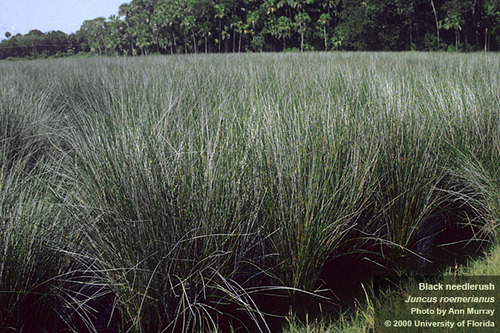
For instance: the lower the marsh, the longer the surface is immersed in tidal waters. Low marshes in North Carolina are dominated by smooth cord grass (Spartina alteriflora). These plants form a monoculture in the areas of the marsh that are regularly flooded by salt water. They have salt glands on their stems that excrete salt. Areas slightly higher in the marsh are dominated by the species black needle rush (Juncus roemarianus).  Here is a picture containing both smooth cord grass and the black needle rush.  (http://www.learnnc.org/lp/media/collections/cede/cedebwr08.jpg) 

Note that the salt marsh cord grass in the picture is close to the water both in the foreground and background. The black needle rush does not appear in the foreground at all, but occupies a zone landward of the cord grass in the marsh in the background. As is probably obvious, the landward portion of the marsh surface is flooded less regularly than the creekside portion. The creek floods out of its banks with each high tide, but it floods deeply enough to immerse the black needle rush zone only a few times each month.

These plants have a very high tolerance for salinity variation. In the high marsh, the salt content of the soil goes up when freshwater evaporates on hot, dry days. As a result, the soil salinity may be more than double that of nearby estuarine water. When it rains, the soil salinity drops rapidly, sometimes to levels near fresh water.

Black needle rush can cover large areas in coastal salt and brackish tidal marshes, and is easily recognizable by its characteristic grayish-green to blackish hues. Its "stem tips" are very sharp pointed and stout. "Stems" in this species are actually leaves that are rounded so tightly that they appear to be very sharp-pointed stems.   Another picture: http://66.media.tumblr.com/f27e5336fa60ab9b6641db5f485fa856/tumblr_inline_n3w1vsPmtF1s71wp9.jpg

Picture of a brackish marsh:
https://www.fws.gov/uploadedImages/Region_4/NWRS/Zone_3/North_Carolina_Coastal_Plain_Refuge_Complex/Alligator_River/Images/BrackishMarsh-520x289.jpg

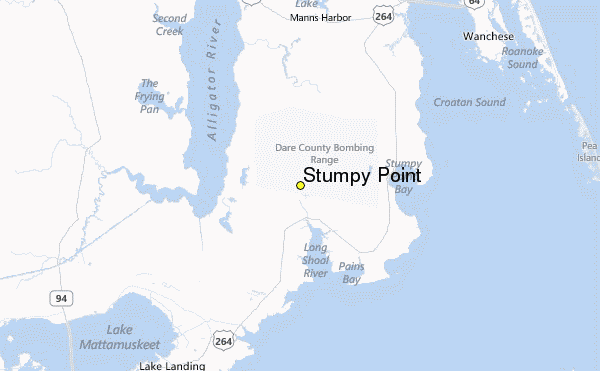
During my research, hoping to find a freshwater source close to the shoreline of Pamlico Sound somewhere between the Algonquian villages Dasemunkepeuc and Pomeiooc, I came upon an article about a once coastal lake formed, possibly, by a forest fire or set deliberately by natives years before 1584, the lake eventually becoming a part of Stumpy Point Bay.  The lake existed as late as the 1700s.  Here is Stumpy Point Bay on a map.  (http://w0.fast-meteo.com/stnlocationmaps/Stumpy-Point.10.gif) 

According to Harold Lee Wise in his book History of Stumpy Point, “John White’s maps of circa 1585 show no indications of Native American settlements there. Still, there is no doubt that Indians, perhaps in their fishing endeavors, were the first to discover the place now called Stumpy Point. The land was part of the Chiefdom of Secotan when Englishmen came to the area in the late 1500s.  … At the time, Stumpy Point Bay was not a bay; rather, it was a lake. On a 1733 map drawn by Edward Moseley, an enclosed body of water labeled Stumpy Point Lake appears. The same name is on another map drawn in 1770; however, by that time, there is a small inlet connecting the lake with the sound, creating a bay.”  Here is the 1733 map.  (https://www.google.com/search?q=stumpy+point+bay,+nc,+map&tbm=isch&tbo=u&source=univ&sa=X&ved=0ahUKEwip9LOMpr_NAhVB2WMKHVdMDOoQ7AkIOQ&biw=1024&bih=694#imgrc=lB8DU6zvX-5lTM%3A)

“A legend arose about the creation of the bay involving the Indians. Lucy Best, a Hyde County native who moved to Stumpy Point in 1903, remembered an old tale passed down to her from previous generations.  … ‘Now all this happened before I ever came to Stumpy Point but they told me that the Indians ... burned out the lake and it took thirteen moons. I don’t guess they knew what dates there was so they counted moons. I don’t know whether it was new moons, full moons or what. But that was the way the lake got burned out. They said it took thirteen moons to burn it out.’

“It may never be known if there is any truth to this old story. Most likely, it is a Native American legend dating far back in their folklore. Indians told a similar ‘burning out’ story about Mattamuskeet Lake. There is a chance it could be based on fact. Because the soil around the area contains peat, lingering ground fires are a big problem for firefighters whenever the forest burns. It is not hard to imagine peat-filled ground smoldering for months and eventually burning completely away enough that water covers the ground enough to create a lake.”

Eventually, the lake became part of Stumpy Point Bay.

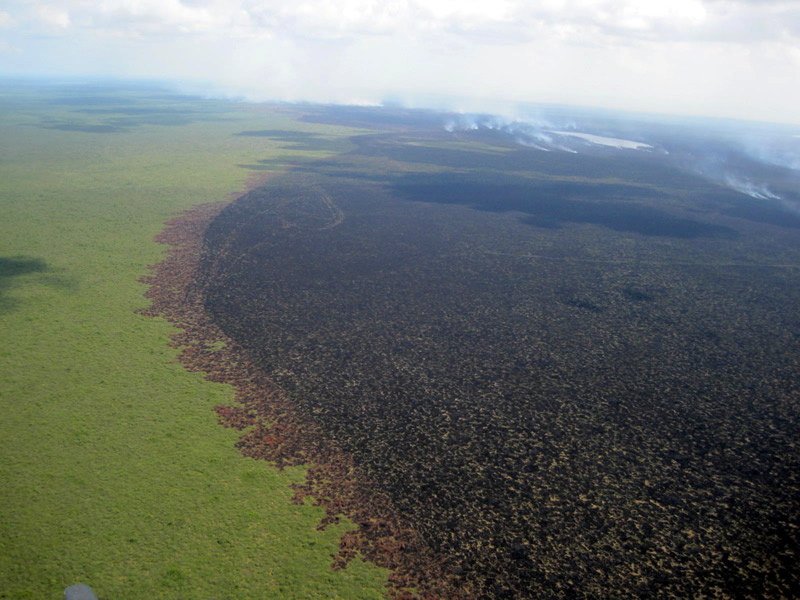
In May 2012, a huge fire consumed thousands of acres of mainland vegetation south of Stumpy Point Bay, precisely what Mr. Wise imagined.  Here is a picture and a map of the area of destruction.  (http://ncforestservice.gov/images/fire_control/pains_bay/029.jpg)
(http://inciweb.nwcg.gov/incident/map/2218/60/17934/)

Salt and brackish marshlands eventually become estuarine shrub/scrub land, which can be defined as any shrub/scrub-dominated community subject to occasional flooding by tides, including wind tides.  Wax myrtle and eastern red cedar predominate.  Downy serviceberry is also present.

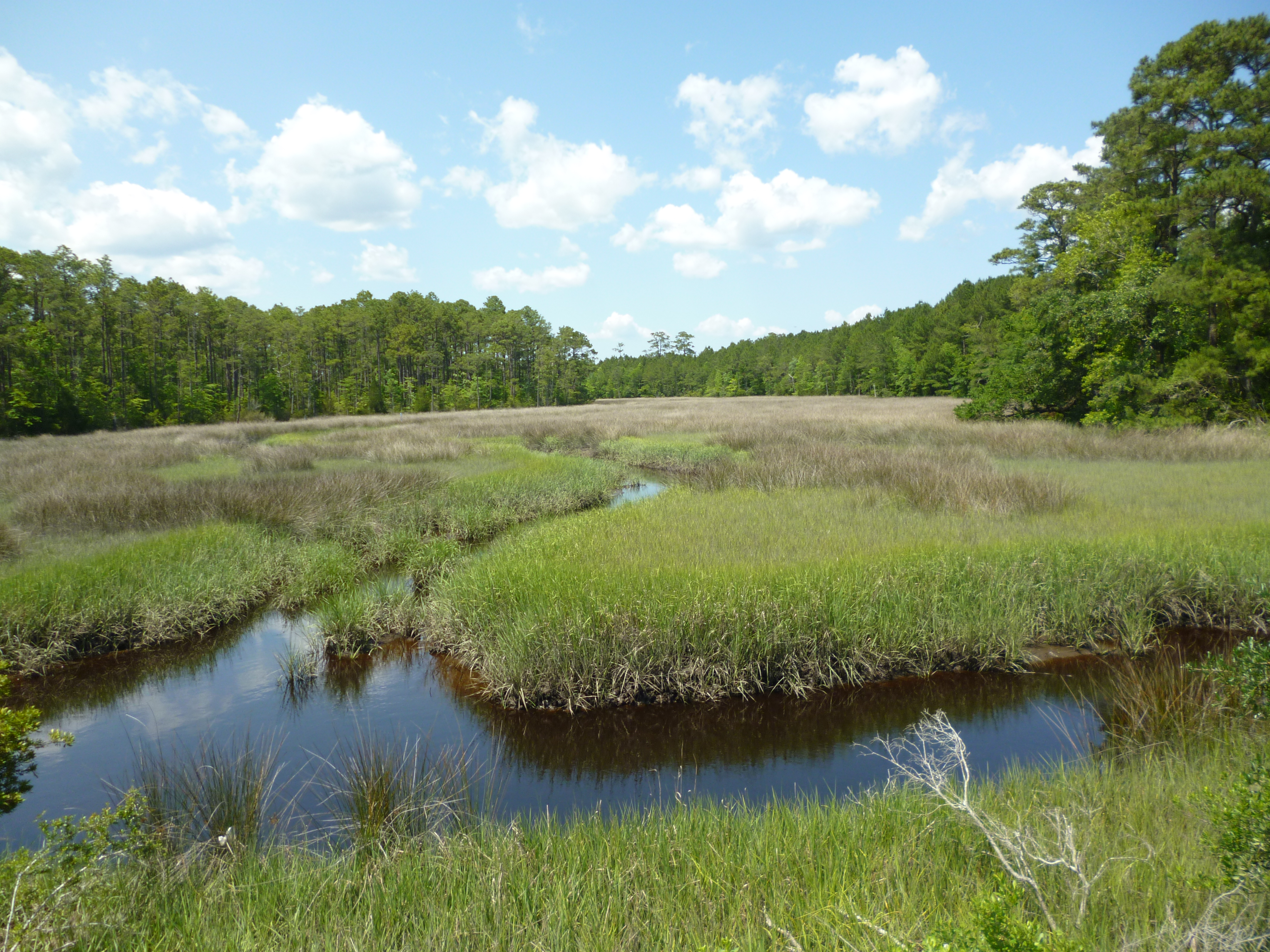
(http://www.learnnc.org/lp/editions/cede_wetlands/520)  Here you see black needle rush along the water’s edge along with a new plant, the freshwater sawgrass (cladium jamaicense) growing landward of it. In the background, you see red cedars growing naturally between the freshwater marsh and the pine forest in the background. In this area the water contains salt only on unusually high tides or when strong onshore winds blow up the estuary. The water here is still affected by the tides. On rising tides river and stream water gets deeper, although most of the time it remains fresh.
 
Fresh water marshes are found farther inland.  They are grassy areas flooded for extended periods during the growing season.  Included are marshes associated with lakes, managed impoundments, some Carolina Bays, and other non-tidal marshes.  Vegetation consists of sedges, millets, rushes, grasses, giant cane, cattail, arrowhead, pickerelweed, arrow arum, and smartweed.  Picture: http://www.learnnc.org/lp/editions/cede_wetlands/515
 
In Alsoomse and Wanchese I have made the eastern shore of the “lake that had been a fire” (not yet a part of Stumpy Point Bay) a salt marsh.  The western shoreline of the lake shares the characteristics of a brackish marsh, a shrub/scrub semi-marsh, and a fresh water marsh.  Here are some excerpts that utilize marsh information.
 
It was mid-afternoon when the occupants of the three canoes, rounding the inward-curving mainland, took their first look at their desired landfall. Wanchese, in the third canoe, scanned the shoreline of tall cordgrass and black needle rush, which they would have to enter, and saw no indication of human activity.  Intent upon the vegetation, he did not see immediately, as Taraquine did, the irregular column of gray smoke rising lazily from somewhere behind the hidden lake.
Taraquine’s curse enlarged his vision.
Pomeiooc women were cooking. That meant their men had already killed game. How many sleeps had they been hunting? How much longer would they remain?
 
They had pushed their way through thick cordgrass to feel beneath their feet mucky ground.  Fairly quickly, at the corner of the lake, far enough away from the ocean water, the salt marsh became wet clay with needle rush and then saturated, peaty soil, hosting sedges, pickerelweed, and arrow arum interspersed with serviceberry, red cedar, and wax myrtle.  A bit farther ashore, where fresh water from underground sources fed into the lake, they had come upon the same brushwood and depressions filled with tall cattails. 
To approach their site, the Pomeiooc would have to travel the ocean facing side of the lake’s shoreline through cordgrass and needle rush or choose the easier way, the mainland side, circumventing more conveniently the flesh-slicing needle rush and colonies of sawgrass.  The women, the two boys, and Huritt’s party were now searching for fuel for the fire. Tanaquincy had gathered the remaining men about him.  Who would wade across the lake to try to locate in the ocean-facing cordgrass the Pomeiooc canoes?
 
The fire, begun during the night, had burned in daylight long enough, in Tanaquincy’s judgment, to alert the Pomeiooc across the lake. Tanaquincy’s group, Huritt’s group, and Taraquine and Tihkoosue from Wanchese’s group had retired into the serviceberry and wax myrtle – the women farther removed – to wait. Wanchese and Machk had kept expanding the breadth of the raft that Tanaquincy, Cossine, Mingan, Wanchese, Machk, and Taraquine had constructed during much of the night.  … Machk and he had laid another relatively straight red cedar limb next to the branches that had already been tied together. Both he and Machk heard simultaneously the sound of wax myrtle branches pushed against and snapped back. They rose instantly from their crouch.
            A voice beyond the wax myrtle reached them. “There are three of us. We come to talk. May we approach?”
 
Pictures:


http://www.dcr.virginia.gov/natural-heritage/natural-communities/image/pvd-photo-500.jpg (a maritime shrub swamp dominated by wax myrtle (Morella cerifera ) and saltmeadow cordgrass (Spartina patens)
 
Downy Serviceberry:
 
Sedges:
 
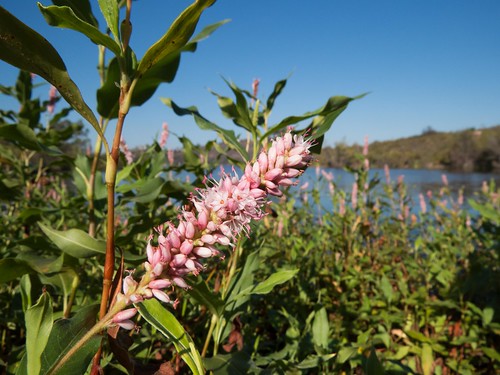
Pickerelweed:
 
Smartweed:
 
Arrow Arum:
 
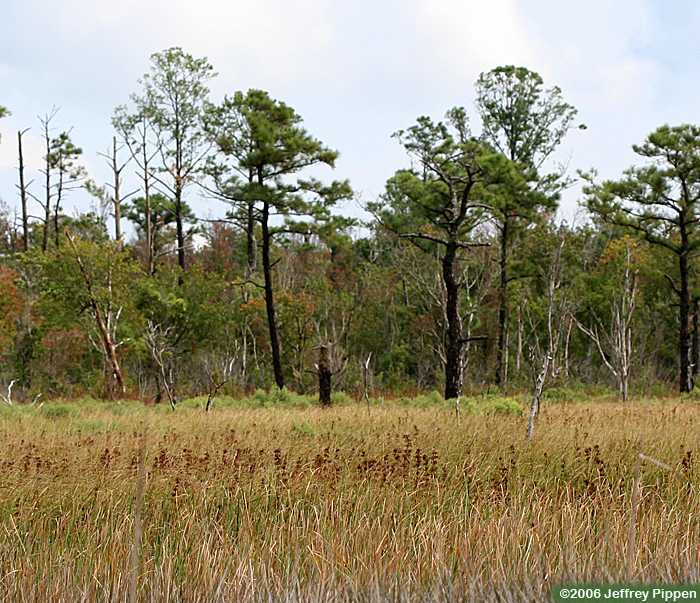
Sawgrass:
 
Millets:
 
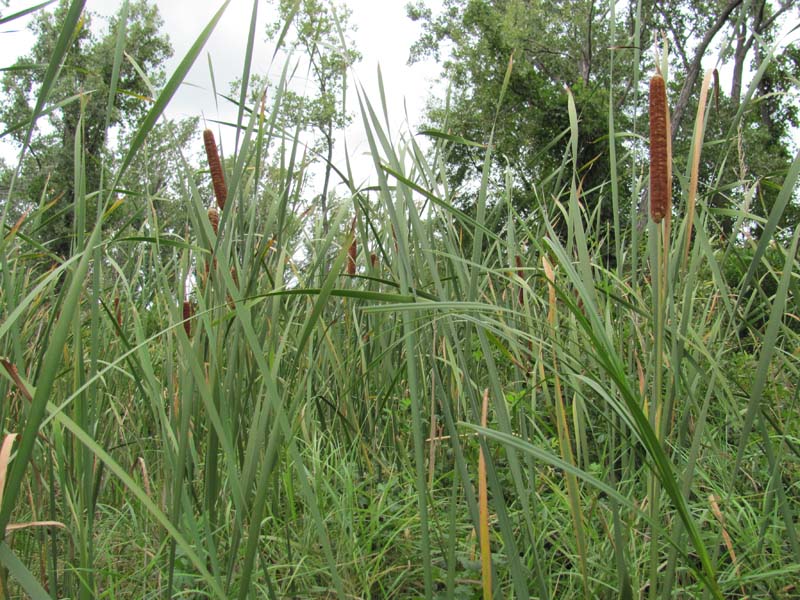
Cattail: