Monday, May 2, 2016

Writing "Alsoomse and Wanchese" -- Trees, Birds, and Fish
 
 
I have never been to North Carolina.  Here I am writing a historical novel that takes place almost entirely outdoors.  The Algonquians of Pamlico and Albemarle Sounds in 1583 depended on plants, trees, birds, fish, crustaceans, and beasts to survive.  I spent more than a year researching the trees, birds, and fish of eastern Carolina before I felt comfortable enough to write my first five chapters.  Here is a brief sample of some of the interesting information I learned and how in excerpts from one chapter I used it.
 
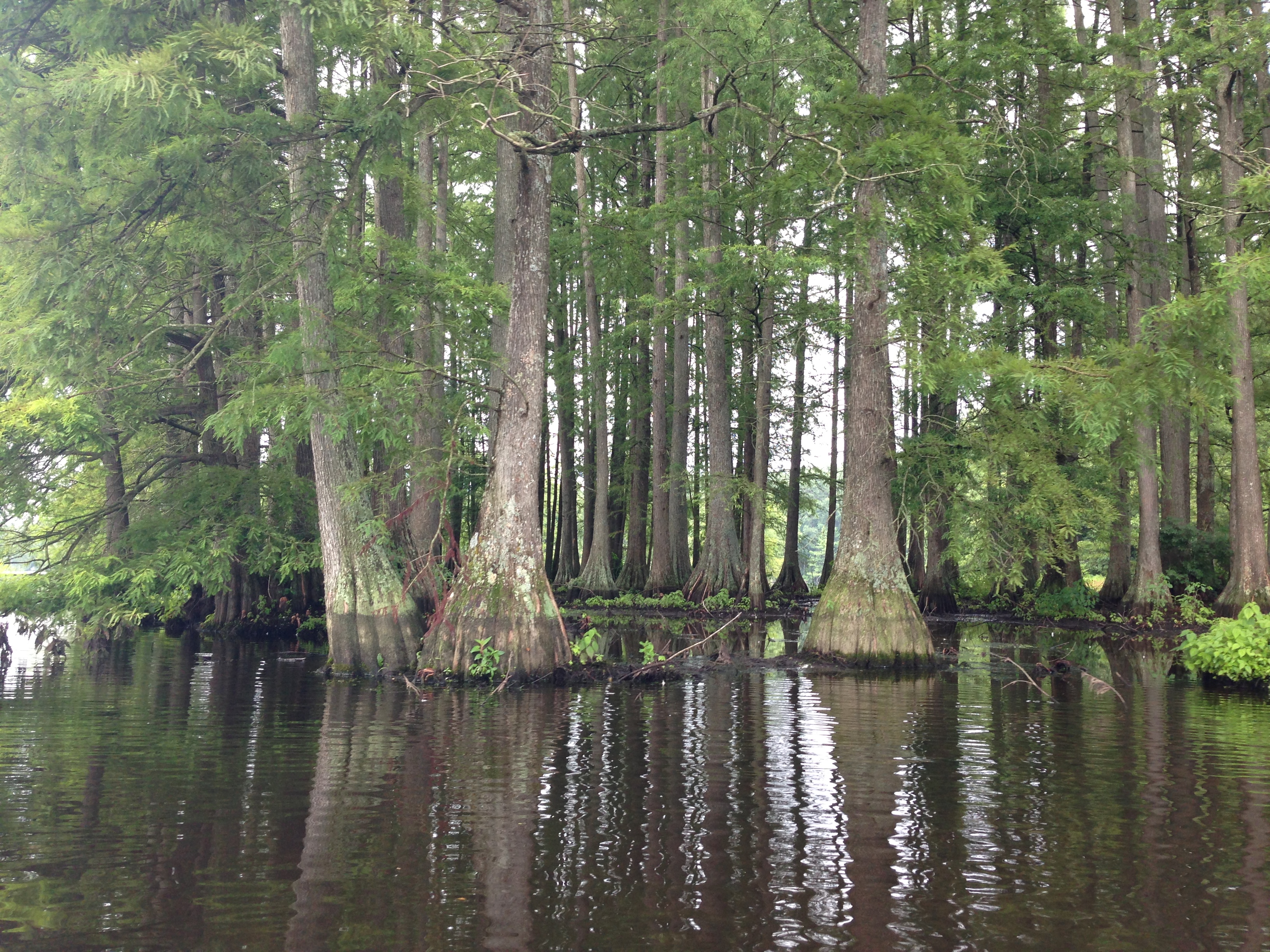
Bald cypress is a long-lived, pyramidal conifer (cone-bearing tree) which grows 50-70' tall (less frequently to 125'). Although it looks like a needled evergreen (same family as redwoods) in summer, it is deciduous ("bald" as the common name suggests).  …  In the deep South, it is a familiar sight growing directly in swampy water, often in large strands, with its branches heavily draped with Spanish moss.  …  Trunks are buttressed (flared or fluted) at the base, and when growing in water, often develop distinctive, knobby root growths ("knees") which protrude above the water surface around the tree. Soft, feathery, yellowish-green foliage (1/4" long, flat needles in two ranks) turns an attractive orange/cinnamon-brown in fall. Rounded, wrinkled, 1 inch diameter, purplish-green cones mature to brown.  It is found along the banks of Albemarle Sound and tributary rivers and creeks where movement of water is sluggish and the terrain is nearly flat.  Picture: https://s-media-cache-ak0.pinimg.com/736x/03/d4/33/03d433f672ea0bca7f7d74a422ee8722.jpg
 
Seldom found far from brackish water, the snowy egret is a fairly common breeder along the coast of North Carolina.  The snowy egret has been described as the “most charming of all our marsh birds.” Whether displaying its gorgeous breeding plumage or racing about in pursuit of small fish in shallow water, it is an exquisite sight, with gleaming white plumage, jet black beak and legs, and bright yellow feet.  In North Carolina, the snowy egret breeds from Currituck Sound to the mouth of the Cape Fear River. It also winters in North Carolina, but in reduced numbers.  Picture: https://roadsendnaturalist.files.wordpress.com/2013/06/snowy-egret-with-feathers-flared-2.jpg
 
Spotted seatrout linger around river mouths throughout the summer and then bunch up in September before traveling upriver to chase baitfish and overwinter.  The spotted seatrout has a long, slender body with a dark bluish-silvery-gray back and silvery sides. Its body is marked by round, black spots on the back, upper sides and extending into the second dorsal fin and the caudal fin. The upper jaw has two large, curved, canine-like teeth.  Spotted seatrout, on average, are 15 to 25 inches in length and 2 to 4 pounds, but they grow to as large as 40 inches and 12 pounds.  The fish is found in rivers, estuaries and shallow coastal waters over sandy bottoms. It is often associated with seagrass beds, as well as salt marshes and tidal pools of high salinity.  Picture: http://www.fishtaxidermytaxidermist.com/Spotted_Seatrout4.JPG
 
White catfish will typically found in slower meandering creeks, streams, canals and small rivers. They are occasionally found in brackish waters which drain into and mix with saltwater. Large specimens rarely exceed 10 pounds and average 2 to 4 pounds in most parts of the country.  The sides are blue-gray to blue-black and may be mottled. The tail is moderately forked.  They have a blunt, more-rounded head, and they lack black spots on their body.  Although fish are their major food, whites also eat larval aquatic insects, small crustaceans, fish eggs and aquatic plants. They may feed at night, but are not as nocturnal as other catfish.  An excellent food fish, whites are prized for their firm, white flesh.   Picture: http://www.ncfishfinder.com/white-catfish-21-fish.html
 
The American black duck, along with the wood duck, mallard, teal and others, is a member of the group of ducks called dabbling ducks. Dabbling ducks are recognized by their ability to “jump” vertically from the water when taking flight and by their dabbling” method of feeding in which they tip up, exposing their rump, when feeding in shallow water.  While in flight, the white underwings provide a striking contrast to the overall black appearance.  In winter, black ducks are visible in North Carolina’s coastal marshes.  Picture: http://ncpedia.org/sites/default/files/blackDuck1.jpg
 
Ospreys are large birds, standing 21 to 24 in. tall and having a wing span of up to approximately 6 ft. This species is always found around water, the larger the water body the better. It is most common along the coast, foraging in sounds, bays, and even in the near-shore ocean. They are dark brown above with white stomach and legs below. The head is white with dark speckles on the crown and a dark brown line through the eye. Two of the best field marks of the osprey are that it flies with crooked or “M”—shaped wings and has dark carpal patches on the under wing. It is the only raptor that actually plunges into the water, entering feet first to catch fish with its talons. The soles of the feet have sharp spiny projections, an adaptation that allows a firm grip on slippery fish.  The osprey is almost always found near water containing abundant fish populations and can be seen along rivers, lakes and the coast. Ospreys are excellent hunters of fish. They usually hover over the water until a fish nears the surface and then dive feet first, grasping the fish with their talons. Ospreys can dive at 30 miles per hour and have been clocked at 50 miles per hour by the time they hit the water. They are able to take off from the water and can be seen shaking vigorously to remove water after they are airborne. Captured fish are almost always carried with head forward for the best aerodynamics.  Ospreys build large, bulky nests of sticks in dead trees, on stumps.  Picture: http://news.cornell.edu/sites/chronicle.cornell/files/OspreyFish7-8.jpg
 
Prior to 1965, the Bald Eagle was a widespread and not uncommon breeding bird along the coast and in the Tidewater areas.  Bald Eagles almost always forage near water, both coastally and inland. They are most numerous at large freshwater lakes, both natural ones (such as Lake Mattamuskeet) and reservoirs (such as Jordan Lake). They also forage at large tidal rivers and bays, but are less numerous in salt water areas such as the ocean or tidal channels. Nest sites are typically in large living pines or cypresses, especially close to water and where the birds have a commanding view of their surroundings.  This magnificent bird has a wing span that reaches approximately eight feet as an adult, and it can weigh more than 15 pounds.  The bald eagle prefers to live in areas near a source of water because it feeds primarily on fish. The American bald eagle forms life-long pair bonds and will usually return to the same nesting area every year. With a relatively long
life span of up to 40 years, the bald eagle does not need to produce very many offspring per year—a female bald eagle will lay one to three eggs a year.
 
 
Excerpts from Chapter 6
 
 
Askook’s canoe sent widening v’s -- the water within them smoother, less sparkling -- back to Wanchese’s canoe some fifty feet behind. To Wanchese’s left stood tall water tupelo and bald cypress and no discernable embankment [https://upload.wikimedia.org/wikipedia/commons/3/37/Bald_Cypress.JPG], entryways of water for inquiry, havens, he recalled, for young boys to idle away time. Looking over his right shoulder, Wanchese could see yet the northern tip of Roanoke Island, where the previous afternoon Alsoomse had insisted that she accompany him. His intuition had told him that she knew that her words were useless but showing a combative attitude was essential, a characteristic of hers he resented and respected. Pity the unfortunate brave so foolish as to take her for his squaw. Yet if he, Wanchese, ever decided upon a young woman to court, she would have to be as nearly strong-minded.
 
…
 
They had left Dasemunkepeuc at midday; little time had passed; Wanchese’s knees and shoulder muscles had not yet begun to hurt. They would do so, however -- notwithstanding the absence of waves -- after they had passed the great egret island that marked their entrance into the long waters. He was hoping to see one or two egrets dash across the shallow surface while others waded, stirring the water with their long black legs and yellow feet. (http://tomrhynephoto.com/wp-content/uploads/2015/01/Frisky-Snowy-Egrets-6.jpg)  As a young boy, he had enjoyed watching egrets. He imagined they would be catching spotted trout now – it being between the seasons Taquitock (fall) and Popanow (winter) – trout, perch, white catfish, sunfish, and black crappie being yet plentiful. (http://www.robsabatiniphotography.com/Wildlife/Outer-Banks-NC/i-FHfLnKm/8/S/IMG_6909ns-S.jpg) Menatonon would surely serve them something special – white catfish he hoped -- when they reached the great Choanoc leader’s village the following day. Something special to look forward to, while he suffered the inevitable pain.
 
…
 
In the back of Andacon’s canoe, wrapped in soft deer hide, were many shell beads and two strings of nearly translucent pearls. Five turtle shells lay exposed, as did fifteen shell-tempered, creatively-stamped pottery bowls. From the forests and waters where the mountains rose and where the sun each day disappeared, through Menatonon mostly, came the essential rocks and stones, thinly rolled wassador (copper), which the elite of Wingina’s followers wore for decoration, red puccoon for medical use and the production of red dye, and antimony, an important ingredient in the making a silver-colored dye.
 
Wanchese had watched Askook’s canoe agitate a flock of black duck tipping for grub, their rumps bobbing in the previously undisturbed water. (http://www.ncwildlife.org/Portals/0/Learning/documents/Profiles/blackduck091411.pdf
He had counted six of them jump from the water’s surface to take immediate flight. Rapid quaking had commenced. He had admired their white underwings, salient contrast to their black heads and bodies, as they had curved inland toward the marshes adjacent to the village.
 
…
 
They were nearing the dead brothers.
 
…
 
“Ah, yes! We do not want to disturb them.”
 
Wanchese had passed the isolated trees twice. [Here is a picture similar to the picture of the trees I describe.  I am not able to find on the internet the original picture. http://edentonchamber.org/webyep-system/data/userfiles/DSC_6376.jpg]
 He had marveled at their stark beauty. They were not dead but they should have been, standing always in water well off the shoreline. Their many thick roots, half a bow’s length above the waterline, reached deep for the estuary’s muddy nutrients. This passing would present different imagery that he would add to his recollection.
 
“Ah! Look! The twin brothers have an occupant!” Osacan pointed.
 
An osprey? Not now. Not for another three moons, Wanchese thought.  He had passed these bald cypresses with Tetepano and the others during their trip to Mequopen during the second earing of the corn. They had watched an osprey dive forty feet from its nest feet-first into the water, reemerge, leap, and rise above the water’s large, rippling circles, huge black and white wings beating, a large fish --  white perch or bluefish -- clutched in its fierce talons.  http://yourshot.nationalgeographic.com/u/ss/fQYSUbVfts-T7pS2VP2wnKyN8wxywmXtY0-FwsgxpCAUHS_fiRtB-g9xwrzxYV3MkxPGruxod-Qs2BTyCnbA/
 
“Bald eagle,” Andacon determined.
 
“That will make the osprey and his mate happy, if they …” Osacan laughed.  “It would be a fight worth seeing!”
 
At the top of the twin trees, where their branches intermingled thickly, inside the large mound of broken apart stick, the eagle perched. Its large downy-white head turned toward them. Yellow talons, yellow beak, scaly-appearing dark brown breast feathers, longer, darker wing feathers: here observed the king of the all creatures that soared! This would not be the eagle’s breeding place, just one convenient stop during his day of hunting. Osacan was wrong. Bald eagles and ospreys rarely fought.
 
They paddled past, every brave’s head turned until he could no longer do so. Wanchese had imprinted the stark beauty: the enlarged base of trunk; the exposed, grasping roots dark brown just above the water; the stiff, sparse, short horizontal branches, longer and more frequent near the top; the spider web-like branch extensions that gave the trees shape; each tree’s rich brown reflection painted on the light blue, still water.
 
How Alsoomse would have enjoyed this, Wanchese thought. Perhaps some day he could take her, and her friends Nana and Odina and Nana’s brother Machk, and, yes, the boy Tihkoosue, and one other paddler here – if ever there was a time when responsibility could wait.


Tuesday, April 26, 2016

Review
"The Trees"
by Conrad Richter
 
 
Conrad Richter’s “The Trees” is the first of a series of three novels called “The Awakening Land.”  The third novel, “The Town,” won the 1951 Pulitzer Prize for fiction.  Based on the quality I perceived in “The Trees,” I intend to read the entire series.
 
One reason I liked this novel so much is that Richter’s characters are so rich and diverse. This is especially true of the Luckett family members, the story’s central characters. 
 
Worth Luckett is ill-suited for settlement life.  He is a “woodsy,” an expert in the ways of hunting, a man who has “itchy feet.”  His driving passion is to hunt and explore places he has never seen.  Soon after the Revolutionary War, when game becomes scarce in frontier Pennsylvania, he moves his family into the nearly impenetrable woods of Ohio where he builds a cabin in a forest so dense that sunlight barely penetrates.  “It was a sea of solid treetops broken only by some gash where deep beneath the foliage an unknown stream made its way,” the author narrates.  Not entirely selfish, Worth demonstrates several times during the story his love for his wife and children.   
 
His wife Jary is a practical-minded, instinctively wise woman who values the presence of neighbors but is loyal to the wishes of her man.  She dislikes the absence of sunlight in the forest where Worth builds their cabin, but she accepts her lot.  “She had had her say and what good did it do her?  The time to have set herself against this place was away back in the old state when Worth claimed the squirrels were leaving the country.  Now she and her young ones were here and here likely they would stay.”  In poor health, Jary dies early in the novel.
 
The eldest of the five children is Sayward Luckett, the novel’s main character.  At the beginning of the novel she is seventeen, intuitive in judgment, strong both physically and emotionally, sensitive to the needs of others, entirely dependable but subservient to no one.  After Jary’s death Worth turns to Sayward to resolve difficult family-matters.  Sayward becomes her siblings’ mother.
 
The next oldest child is Genny, sweet in disposition, physically attractive, a gentle, naive soul whose presence enriches the lives of her family members and of neighbors the family eventually meets.  She is a vulnerable character about whom we feel protective.  The author places her in a situation that causes us much concern.
 
The third oldest child is Achsa, quite the opposite of Genny.  Achsa is physically powerful and cynical.  She frequently taunts her siblings -- especially Genny.  She has a mean streak.  We discover that she is quite devious.
 
The second youngest child is Wyitt, the only boy.  Wyitt is a reincarnation of his father.  He is a proud, bull-headed boy determined to become as skilled a hunter as his father.  Like his father, he is not entirely self-absorbed.  In several important instances he demonstrates his love for his sisters.
 
The youngest child is Sulie, the apple of Worth’s eye.  She is spirited, inquisitive, honest in her actions, not hesitant in expressing her feelings and beliefs.  “One time she could look at you with such a helpless mouth, and then when you least expected it, she was spunky as a young coon and said grand things that no one dared think of.”  Like Genny, she is a “beloved character,” somebody we especially want protected.  The author places her also in a situation that causes us substantial concern.
 
Several other characters are well crafted.  Two are particularly important.  There is Louie Scurrah, a villain of sorts, a former companion of the historical person Simon Girty.  Scurrah and Girty had lived with Indians and participated in the torture of American soldiers prior to the Revolutionary War.  Louie is a charmer whom only Sayward and Sulie continue to distrust.   The other important character is Portius Wheeler, the “Solitary,” an eloquent Bay State lawyer who had chosen to live “out in the bush by his lonesome.  Most times you couldn’t get any more talk out of him than a deaf and dumb mute.”
 
I appreciated just as much the novel’s feel of authenticity. 
 
First of all, the story is historically informative.  I read how a forest cabin was built, what animals were hunted, what material goods forest women valued, what food was cooked, what tools a “woodsy” needed, what goods the local trading post desired and traded, what clothes were worn, and in a cabin housing seven people what comprised beds. 
 
Visual detail also provides authenticity.
 
She [Sayward] could see him [Wyitt] in her mind, yonder through the ups and downs of life, skinning deer and trap-drowned mink and otter, giving a rap over the head to foxes that hid in bushes ashamed to be caught and to coons that sat up as big as you please on a log as if they didn’t have a trap and clog hanging to one paw.  Snared panthers would shed real tears when he pulled out his hunting knife, and beaver would swim out of their smashed houses and find he had left no ice for them to come up and breathe under. …
 
That shock of sandy hair would be farther down over his shoulders then and his young face that had hardly fuzz on it as yet would be covered thick with a sandy beard.  His buckskins would be bloody where he wiped his hands, and his hair would be full of nits.  Not often would he wash, least of all his itchy feet. 
 
Adding to the feeling of authenticity is the author’s style of narration.  Here is an example -- Genny’s observation of preparations for a Fourth of July celebration.
 
She had almost forgotten how it felt to get among a passel of folks on pleasure bent.  The young ones were making high jack all over the place, wrestling and fighting, racing and wading, swinging on creepers, every last one yelling at the other and none listening.  Some of the men were pulling a flag up on a high hickory limb.  Others were laying meat over a pit of white oak coals to roast.  This was one time, they said, when the he’s would show the she’s how to cook.  The women didn’t mind.  They were glad to get out of it for once and go off to themselves yonder on some logs with nothing to do but lay their littlest ones on patches of moss and swap news among themselves.
 
We witness authenticity also in the way characters speak.
 
Genny is concerned that her sister Sayward, whom she admires, might want to marry Jake Tench, a settlement man rumored to have fathered several Indian children.  He and a boy who has a romantic interested in Genny come calling.  After the two males leave, Genny demonstrates silently her displeasure.
 
“What’s a ailin’ you?” Sayward broke out at last.
Genny turned her back
“You needn’t talk to me after what you done.”
“Now I done something and don’t know what it was,” Sayward complained.
“You know good enough,” Genny told her.  “Jake Tench!
She could feel Sayward shake with quiet laughter.
“Don’t you fret about Jake.  He mought make free with a Shawanee wench but he kain’t with me.”
“He mought marry you,” Genny said.
Sayward’s voice hardened.
“Not him,” she told her shortly.  “Nor any other man where spits in my fire when I got bread a bakin’.”
 
Lastly, I value this novel for its portrayal of the universality of life.  Good and bad people and a lot of people in between populate “The Trees,” as they have done so and do in real life.  Conrad Richter’s characters mattered to me.  Passages, like this one, stirred my emotions.
 
When they let her back to the bed, Jary was light as a pack of dried and brittle fox skins.  Through the folds of homespun Sayward thought she could feel a coldness like stone.  ….
 
He [Worth] turned and went to the open door and looked out at the black forest where gray daylight was just beginning to come.  No use turning your back on this, Sayward wanted to tell him.  Whether you looked or no, death would come and life would go.  Up in the loft all signs of the young ones had vanished.  Sayward reckoned they were lying face down on their beds.
 
Sayward reflects at the end of the novel: “Let the good come … for the bad would come of its own self.  …  That’s how life was, death and birth, grub and harvest, rain and clearing, winter and summer.  You had to take one with the other, for that’s the way it ran.”  The particulars of this theme and the excellence of the writing make “The Trees” a quality novel.


Sunday, April 17, 2016

Frederick Douglass -- Brutalizing Slaves
 
Aunt Hester went out one night and happened to be absent when my master desired her presence.  He had warned her that she must never let him catch her in company with a young man who was paying attention to her.  The young man’s name was Ned Roberts, generally called Lloyd’s Ned.  She was a woman of noble form and of graceful proportions, having few equals in personal appearance among the colored or white women of our neighborhood.
 
Aunt Hester had not only disobeyed his orders in going out but had been found in company with Lloyd’s Ned.  I learned this from what he [Anthony] said while whipping her.  Before he commenced whipping Aunt Hester, he took her into the kitchen and stripped her from neck to waist.  After crossing her hands he tied them with a strong rope and led her to a stool under a large hook in the joist put in for the purpose.  He made her get upon the stool and tied her hands to the hook.  Her arms were stretched up at their full length so that she stood upon the ends of her toes.  He then said to her, “Now you …, I’ll learn you how to disobey my orders!”  After rolling up his sleeves he commenced to lay on the heavy cowskin, and soon the warm, red blood came dripping to the floor.  I was so terrified and horror-stricken that I hid myself in a closet.  It was all new to me.  I had always lived with my grandmother on the outskirts of the plantation where she was put to raise the children of the younger women” (Bontemps 33-34). 
 
Aaron Anthony, Frederick’s master, was fifty-seven and a widower for eight years when Frederick moved into the plantation manager’s house to live.  Anthony himself owned two or three farms and about thirty slaves.  He left the management of his own property to an overseer named Plummer, “a miserable drunkard, a profane swearer and a savage monster” (Bontemps 32).  As a young man Anthony had gotten a job on Colonel Lloyd’s sloop, which transported the former governor’s bounty of produce and products to nearby Baltimore, and Anthony earned the title, “Captain.”  Eventually he became the “overseer of overseers,” the manager of Colonel Lloyd’s vast land holdings and some 1,000 slaves.
 
Frederick’s exposure to the violent treatment of slaves by their masters and overseers occurred at an impressionable age.  The beatings that he witnessed and the stories of other beatings told to him during his two year residence at Wye House he remembered with clarity and used years later to enthrall and repel those in the Northern states who came to hear him speak for the abolition of slavery.
 
The first overseer to whom Frederick was directly responsible was a man named Severe.
 
Mr. Severe was rightly named: he was a cruel man.  I have seen him whip a woman, causing the blood to run half an hour at the time; and this, too, in the midst of crying children, pleading for their mother’s release.  Added to his cruelty, he was a profane swearer.  It was enough to chill the blood and stiffen the hair of an ordinary man to hear him talk. … From the rising till the going down of the sun, he was cursing, raving, cutting, and slashing among the slaves of the field, in the most frightful manner.  His career was short.  He died very soon after I went to Colonel Lloyd’s … His death was regarded by the slaves as the result of a merciful providence.
 
Mr. Severe’s place was filled by a Mr. Hopkins.  He was a very different man.  He was less cruel, less profane, and made less noise … He whipped, but seemed to take no pleasure in it.  He was called by the slaves a good overseer.
 
…
 
Mr. Hopkins remained but a short time in the office of overseer.  Why his career was so short, I do not know, but suppose he lacked the necessary severity to suit Colonel Lloyd.  Mr. Hopkins was succeeded by Mr. Austin Gore … Mr. Gore had served Colonel Lloyd, in the capacity of overseer, upon one of the out-farms, and had shown himself worthy of the high station of overseer upon the home of Great House Farm.
 
… There was no answering back to him; no explanation was allowed a slave, showing himself to have been wrongfully accused.  … No matter how innocent a slave might be—it availed him nothing, when accused by Mr. Gore of any misdemeanor.  To be accused was to be convicted, and to be convicted was to be punished … He was, of all the overseers, the most dreaded by the slaves” (Douglass 29-30).
 
…
 
… Mr. Gore once undertook to whip one of Colonel Lloyd’s slaves, by the name of Demby.  He had given Demby but few stripes, when, to get rid of the scouring, he ran and plunged himself in a creek, and stood there at the depth of his shoulders, refusing to come out.  Mr. Gore told him that he would give him three calls, and that, if he did not come out at the third call, he would shoot him.  Demby made no response, but stood his ground.  The second and third calls were given with the same result.  Mr. Gore then, without consultation or deliberation with any one, … raised his musket to his face, taking deadly aim at his standing victim, and in an instant poor Demby was no more.  His mangled body sank out of sight, and blood and brains marked the water where he had stood.
 
… He was asked by Colonel Lloyd and my old master, why he resorted to this extraordinary expedient.  His replay was … that Demby had become unmanageable.  He was setting a dangerous example to the other slaves … He argued that if one slave refused to be corrected, and escaped with his life, the other slaves would soon copy the example … Mr. Gore’s defence was satisfactory.  He was continued in his station as overseer upon the home plantation” (Douglass 38-40).
 
Killing a slave was not considered a crime.  However, it was a practice that was not looked upon favorably.  A slave killed was property forever lost.  Better to sell an unmanageable slave to the labor-killing plantations of Georgia.  Nonetheless, when it did occur, the murderer knew he would not be convicted in a court of law.  To illustrate this fact, Frederick wrote about the murder of a cousin of his wife.
 
The wife of Mr. Giles Hicks, living but a short distance from where I used to live [years later in Baltimore], murdered my wife’s cousin, a young girl between fifteen and sixteen years of age. … The offence for which this girl was thus murdered was this:-She had been set that night to mind Mrs. Hick’s baby, and during the night she fell asleep, and the baby cried.  She, having lost her rest for several nights previous, did not hear the crying.  They were both in the room with Mrs. Hicks.  Mrs. Hicks, finding the girl slow to move, jumped from her bed, seized an oak stick of wood by the fireplace, and with it broke the girl’s nose and breastbone, and thus ended her life” (Douglass 41).
 
 
Works cited:
 
Bontemps, Arna.  Free at Last: The Life of Frederick Douglass.  New York, Dodd, Mead & Company, 1971.  Print. 
 
Douglass, Frederick.  Narrative of the Life of Frederick Douglass.  New York, Penguin Books USA inc., 1968.  Print.


Sunday, April 10, 2016

Frederick Douglass -- "Grandmanny's Gone"
 
Pictures:
 
 
Quotations:
 
“Once you learn to read, you will be forever free.”
 
“It is easier to build strong children than to repair broken men.”
 
“If there is no struggle, there is no progress.”
 
"Power concedes nothing without a demand. It never did and it never will.”
 
“The white man's happiness cannot be purchased by the black man's misery.”
 
“To suppress free speech is a double wrong. It violates the rights of the hearer as well as those of the speaker.”
 
“I would unite with anybody to do right and with nobody to do wrong.”
 
Introductory Comment:
 
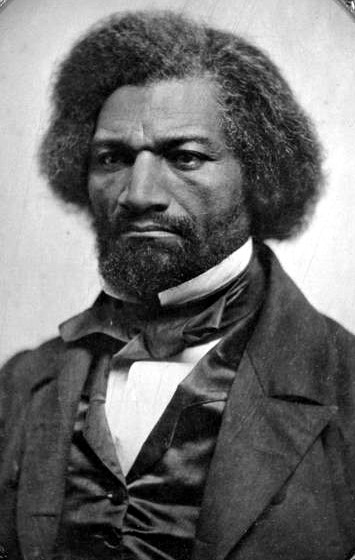
I became especially interested in Frederick Douglass after I read his fascinating autobiography, Narrative of the Life of Frederick Douglass, an American Slave.  Years ago, after retiring, I wrote a manuscript about him that I hoped eighth grade students at the school where I had taught would be assigned at least in part to read.  Beginning with this post, I will be sharing with you much of what I wrote.
 
***
 
On a summer day in August 1824, when Frederick was six, he and his grandmother left the cabin, walked up to the cross roads, and turned southwest.  The walk was long, much longer he soon learned than the one in the other direction, to Hillsboro, probably the only town he had been to.  For much of the trip his powerful grandmother must have had to carry the tall, heavy child.   … there was no horse the resourceful Betsy could commandeer for the day.  Turning at one crossroads town, they walked between great fields, blackened in heat, to reach another, and soaked in perspiration kept resolutely on through the Lloyds’ “Long Woods.”  Finally, having walked twelve miles, they came to Wye House.  A generous lawn’s-width short of the long, straight drive leading under great trees to the main house was a parallel road that led to the slave quarters.  They took it; through the trees between the narrow roads, Frederick could catch sight of the great house.  As the two of them came past, they reached their master’s small, neat cottage and the quarters where their relatives lived.  Looking off the other way across Long Green they saw the broad stretch of the Wye River.
 
Suddenly, the long, hot trek was over.  Curious children came out to look over the newcomer, and followed him and their grandmother into the kitchen, where the two got desperately needed drinks of water.  Cautiously, Frederick agreed to go back into the yard with them, but he did not join in as they ran “laughing and yelling around me.” Their exuberance would have been more intimidating if he had not known that his grandmother was back in the house.  But soon she was not.  Taking what she saw as the least tormenting way to accomplish the parting she was resigned to, Betsy quietly left to walk the long miles back to Tuckahoe.  When one of the children, with “roughish glee” shrieked at him, “Fed, Fed! Grandmammy gone!” he fled back to the kitchen to find her.
 
But she was gone.  He rushed out to the road; she was not in sight, and he could not run down its emptiness alone.  He threw himself on the ground, and crying, pummeled the dry dust.  When his older brother, Perry, tried to console him with a peach, he threw it away.  He was carried in to bed and cried himself to sleep.  And he never fully trusted anyone again (McFeely 10).
 
Maps:
 
Frederick Bailey was born near the banks of the Tuckahoe, a quiet creek that cut through fields and woods of Maryland’s Eastern Shore eventually to reach the Choptank River, which, in turn, emptied itself into Chesapeake Bay.  He lived the first seven years of his life in and about a solitary cabin in a wood on one of two adjacent farms owned by Aaron Anthony, his slave master.  The cabin belonged to Isaac and Betsy Bailey, his grandparents.
 
Isaac, about whom Frederick would write very little, was a free black man.  He worked as a sawyer, a tree and lot cutter.  It was Betsy Bailey who was the dominant parental influence of Frederick’s early life.
 
She was a tall, strong, copper-dark, intelligent woman who had been given, or assigned, the task of raising for the first seven years of their lives the offspring of her daughters, who labored in the fields nearby or distant for their master or for other white men who had rented their services.  Betsy had belonged to Ann Catherine Skinner but had become Aaron Anthony’s property upon her mistress’s marriage to him.  Because she was a slave, his slave, her children became his slaves as well.  Frederick’s mother, Harriet, was Betsey’s second daughter.
 
Frederick remembered nothing of his mother until he had begun living at the Wye House, when his life with his grandmother was severed.  Frederick’s father?  About the cabin in the woods and more emphatically during his two years at the Wye House he heard the rumors that his father was a white man; his skin color attested to it.  Perhaps his father was his master!  That his father was a white man Frederick, the adult, was certain; who he was – Aaron Anthony, or someone else who had encountered his mother during her brief adult life – he was never certain.
 
Perhaps because of the task assigned to her, Betsy Bailey, Frederick’s grandmother, was allowed to live apart from Anthony’s other slaves and to abide by her own rules.  As a consequence, Frederick knew little of the bondage and brutality of slavery while he lived with her and his young cousins.  He could watch and chase the rabbits and deer that ventured into the fields from the woods.  He could sit beside the turtles that sunned themselves on logs in the Tuckahoe.  He could sink his toes in the clay bottoms of shallow pools and watch skater bugs glide over them if he wished.  Birds, in great number, dominated the morning with their noise.  At migrating time great flocks of ducks settled on the marsh water below a mill dam.  Frederick recalled splashing into the creek without having to take off his clothes; he wore only a shirt.  He recalled mimicking farm animals and being fed “corn-meal mush” with an oyster shell for a spoon.  As an adult he assessed the material poverty of his early existence; as a youngster he was oblivious of it.
 
They subsisted independently.  Isaac’s woodcutting, and more importantly, Betsy’s expert fishing and farming permitted their existence together.  Betsey’s nets were in “great demand” in Hillsboro and Denton, nearby towns.  Frederick remembered her “in the water half the day” gathering an abundance of shad and herring.  In the spring she planted her own sweet potatoes and then helped with the planting of her neighbors’ crop.  At harvest time, she pierced the ground so deftly with her fork that none of her crop was ever punctured or lost.  Always she put aside good seed potatoes for the next season’s planting.
 
The untroubled life that Frederick and his cousins enjoyed at the cabin had been purchased, of course, at a great cost.  Before each was old enough to be taught the skills of fishing and farming to help her with her labors, Betsy was required to accompany each the twelve miles to the Wye House, where Aaron Anthony lived, where he managed the vast estate of Edward Lloyd, a former governor of the state and United States senator.  Here each child would begin abruptly his or her own harsh life of slavery, bereft without warning of the comfort of the only parenting he or she had known.
 
 
Work cited:
 
McFeely, William S.  Frederick Douglass.  New York, W. W. Norton & Company, 1991.  Print.


Friday, April 1, 2016

Writing "Alsoomse and Wanchese" -- English Intentions
 
This novel is almost entirely an imaginary account of the lives of certain Algonquian natives (some of whom existed) at and near Roanoke Island from the fall of 1583 to August 1584.  I will end it with two natives being taken to England by an English exploratory party to be taught English and to be returned the following year.  To prepare the reader for the party’s sudden appearance, I have included several scenes that indicate English intentions of establishing an Atlantic coastline settlement.  Here are some excerpts of these scenes.
 
Sir Humphrey Gilbert’s Failure to Establish a Settlement South of Newfoundland
 
Humphrey Gilbert and his crew sensed how close to Sable Island’s rocks the Squirrel, riding the crests of turbulent waves, had come. If he dared to put out to sea, how many days or weeks would it be before he would be able to return? On this island roamed wild pigs and cattle, set ashore decades ago by Portuguese explorers. He had to replenish his food supply! The alternative was to return to the Queen disgraced! The Newfoundland fishermen had warned him about Sable Island, about how in bad weather too many ships had been destroyed on its rocks. “Approach it in the best of conditions. And lead with your smallest ship.” Well, in both instances he had done the opposite.
And he had also spurned the advice of the Delight’s master, Richard Clarke.
“If you must, utilize a south-west-south course.”
Clarke had contradicted his west-north-west direction. “That will take you to disaster, Admiral. The wind is at south and night is at hand. Unknown sands lay a great way off the land.” He had had to threaten to bring down Elizabeth’s wrath to force the master to comply. 
Slanting rain pelted him. He turned his face away from its force. Minutes passed. Sailors were staring at him, turning their faces when he attempted to make eye contact. He would wait a bit longer!
If the fog lifted, he could then be certain. If not, … The waiting was interminable! He stared, at drifting, amorphous shapes.
A ferocious blast of wind caused him to slip and then fall on the rain-drenched deck. He careened down the deck’s slope, his right leg striking stanchions. Adjusting to the roll of the ship, gripping a foremast spar, painfully, he stood. The boards beneath his feet trembled. Fear constricted his throat.
“Admiral! Here!”
Gilbert hesitated, then followed the beckoning sailor to a cluster of four seamen just aft of broadside. There! The fog had opened. Gilbert's lead ship, the Delight, his largest, was coming apart on dark rocks. And in the water . . . the ship's crew: heads, flailing arms. Miraculously, a boat in the water, just beyond, in one eye-blink, capsized. Churning bodies, disappearing. Gone!
 
Walter Raleigh Seeks to Obtain Humphrey Gilbert’s Patent to Colonize
 
Thinking about Hatton, Raleigh laughed. Hatton played the courtly game of unrequited lover -- which Elizabeth loved so much -- but he, Raleigh, was much better at it. Two months ago using his diamond ring he had carved on a lattice window in the Queen’s Presence Room the message: “Fain would I climb, yet I fear to fall.” Taking his ring from him the next day, she had inscribed: “If thy heart fails thee, climb not at all.”
To Elizabeth, he was “Water.” He was her Shepherd of the Ocean. She “died of thirst” whenever he left her presence. In his poems he called her Cynthia, goddess of the moon and symbol of chastity. He had penned the past two days two stanzas that, if he were quick about it, he might complete before her inevitable summons. He walked to his desk, bent over its surface, and read them.
 
Those eyes which set my fancy on a fire,
Those crisped hairs which hold my heart in chains,
Those dainty hands which conquered my desire,
That wit which on my thought does hold the reins!
 
Those eyes for clearness do the stars surpass,
Those hairs obscure the brightness of the sun,
Those hands more bright than every ivory was,
That wit even to the skies hath glory won.
 
 He thought that one more stanza might suffice. He would sit at his desk this very afternoon to write it if he were not summoned. If not this day, then he would tomorrow. She would read it; he would gain greater favor;he would press more aggressively his request to acquire Gilbert’s patent.
…
He had not been summoned. Riding the newly paved road to the palace the following morning, Raleigh thought about his goal. He had competition. Because of what Humphrey had experienced, he believed he knew his competitor’s identity.
            Francis Walsingham, the Queen’s primary secretary.  Humphrey had communicated his frustration during the final days before he had left England for Newfoundland.
…
Gilbert had learned that Walsingham, his stepson Christopher Carleill, and Sir George Peckham had interviewed the English seaman David Ingram about his purported journey by foot past the Chesapeake Bay all the way to Cape Breton. “Why their particular interest, Walter? Why their interest?” Humphrey had asked him sarcastically.
…
Captain Edward Hayes and the Golden Hind had returned to England September 22. The news: Raleigh’s half brother and good friend and his ship the Squirrel and crew had been swallowed in a violent storm.
Raleigh had quickly set in motion plans to outfit his own expedition. He had gathered together already at Durham House diverse people to ensure that his expedition would be thoughtfully organized and well equipped. Sometime in April of 1584 he expected to send two or more ships to North America, perhaps somewhat south of Gilbert’s intended settlement, to locate a practical place to found a settlement and base for privateers to attack King Philip’s treasure ships. He believed he could convince Elizabeth to award him Humphrey’s patent. But he had to be watchful! Walsingham, and Carleill, would not be standing still.
 
Introduction of Thomas Harriot, an Important Member of the 1584 English Voyage
 
It was raining. Walter Raleigh heard the steady drumming on the roof and the course of water in the rain gutter above Haritt’s room on the second floor of the Durham House. His employee was instructing another class of sea captains in the use of navigational instruments and his tables of corrections of mathematical findings that the instruments provided.
Dressed in black – Raleigh had never seen him wear clothing of any other color – Harriot, but 23 years old, was holding before his four students a quadrant. “Latitude, gentleman.” The young man held the quarter circle-shaped instrument eye-level tilted upward. “Any sea venture you attempt requires that you must know frequently your latitude.  This instrument, as two of you well know, is one of the simplest ways of determining that.” He lowered the quadrant, smiled, extended his left hand as if to convey an apology. “Captains Harris and Sturges, you could demonstrate the employment of this instrument as easily as I. To our distinguished gentlemen also attending, my demonstration, I believe, is essential to their basic understanding.”
Appreciating his employee’s mathematical aptitude, attention to detail, and insatiable curiosity, Raleigh had encouraged Harriot to attack the sea captain’s seemingly insurmountable difficulty of determining by celestial observation his location where there was no land to guide him. He had sent Harriot to the London and Plymouth docks to interview grizzled seamen, preferably captains, over pints of ale in bawdy taverns, to learn everything he could about sailing ships, life at sea, and the ways captains navigated. Among various titles of inquiry an astronomer, Harriot had researched what the ancients, and later the Arabs, had discovered about the constellations and the measurement of time. He had read as well two modern publications about this vital subject: John Dee’s translation into English in 1570 of Martin Cortes’s Arte de navigation and, printed in 1574, William Bourne’s A Regiment for the Sea, a corrected and expanded version of Cortes’s work.  In short, Raleigh believed that Harriot knew more about the reading of the sun and stars, the instruments used, and the imperfections of those readings and how they could be partially corrected than any English seaman alive.
 
Queen Elizabeth and Walsingham Talk about Colonization
 
The food-tasting for poison was essential. Guarded in her residence day and night, never left alone, she was less likely to be assassinated directly. Poisoning – indirect assassination --was subtle, more achievable.
There had been ample reason for concern. For her entire reign she had had to confront the ramifications of her renunciation of Catholicism. Only by threatening to marry the heir to the French throne had she been able to forestall Philip of Spain from authorizing military action to depose her. This tactic had not stopped Catholics in England and Europe from scheming to remove her and reestablish Catholic rule in the person of Mary Stuart, Elizabeth’s cousin, former queen consort of France, former Queen of Scotland, forced to abdicate her Scottish throne by Protestant lord.,Tthe past fifteen years per Elizabeth’s orders, Mary had been  confined at Sheffield Castle closely watched by Sir Francis Walsingham’s numerous spies.
…
The interview had concluded. Yet he tarried.
“God’s love, rise!” It occurred to her that he had more to say.  “Yes?”
He rose, with reluctance towered over her.
“A matter of collateral urgency.” His dark eyes connected.
“How so?”
“The expedition to the New World. We must found a colony north of Florida but south of where Gilbert had planned to colonize so as to seize in the Caribbean and south of the Azores Spanish gold, and, simultaneously, discover comparable riches!”
“We have spoken about thi!. You know the treasury lacks the funds to finance this venture! You must show me a plan that involves private investment! I wait to see such a plan!”
“I am close to showing you a plan.”
“You do know that you have competition.”
She saw in his eyes a flash of temper, despite his skill of suppressing emotion.
“You speak for my issuance of a patent, similar to that I gave Gilbert. Authorization to sell vast acreage to wealthy investors.”
“How else am I to raise sufficient capital?”
“Agreed. And who is to hold this patent, and grandly profit from it? Your step- son, Christopher Carleill?”
“He would be the captain.”
“But who would hold the patent? You?”
His eyes did not deviate. “Who but I have the connections to make such a risky, complicated venture successful?”
“Again, agreed. I will look at your plan.”
Walsingham having left, she was not of the mood to translate or nap. Her ire was up. Walsingham wanted his due. He expected it! Early during her reign, advisors had thought they could intimidate her, because she was a woman. There were times when Walsingham tried. She had allowed no man to control her nor had she any advisor to become too powerful.
 
Queen Elizabeth and Walsingham II
 
Grunting, Walsingham shifted his weight onto his left knee. He sought silently permission to rise.
Instead, “Speak.”
“The plot involves the Pope, the Guise family, and the Jesuits. It is part of King Philip’s planned enterprise. Mary Stuart and Ambassador Mendoza are fully informed. We are to be invaded at four locations.”
“Where?’
“Scotland, Ireland, Sussex, and Norfolk. All coordinated by Catholic activists foreign and national.”
“Your recommendation?”
“The executioner’s blade.”
“Always.”  She frowned. “Throckmorton, yes. I agree. They will know that we will not countenance them!”
“The Scottish whore?” Walsingham’s dark brow furrowed all the more.
“You question God’s divine right to anoint kings?”
They responded rapidly.
“She commits treason!”
“The punishment will be continued isolation, confinement.”
“The Council will demand execution! As will Parliament!”
“I will not call Parliament into session! The Council advises, does not overrule my decisions! Have you again forgotten yourself?”
His anger reached dangerously across the intervening space.
No, this would not answer. It remained for her to defuse the friction. “You, Sir Francis, serve me best, I believe, of any man of this realm. Keep your spies active. You and they keep your sovereign and her people safe! Know that I value your opinions highly, but know that I do not submit to them! Continue, therefore, to presume to declare them, even if you must smolder privately because of their rejection. Know as well that you shall be rewarded personally for your zealous service. I am not an ungenerous queen.”
 
Raleigh’s Preparations
 
Raleigh looked directly at Arthur Barlowe, who was staring at him from across the table. “You, Arthur. I know you well from our recent Ireland days. Your seamanship in the Mediterranean precedes you. You have been involved in this planning from the beginning. I trust your judgment. I want you in command. You are not so old at 34 – Is that correct? – that you cannot withstand the rigors of an Atlantic crossing? What say you?!”
“I would be honored,” Barlowe responded.
“And I would like to bestow upon my adventurous relative, at the tender age of 19 -- here among us -- the opportunity to distinguish himself similarly!” Harriot and those closest to him looked at Philip Amadas, vain, in Harriot’s opinion given to impulsive behavior. Amadas had ingratiated himself by releasing to Raleigh his estate in the manors of Trethake, Penkelewe, and had taken permanent lodging at Durham House. Barlowe and Amadas had also been Harriot’s students. They were to sail to the New World!  Would he?
“The esteemed Doctor Dee three years ago declared that the problems of navigation are best solved by a mathematician. We have an excellent mathematician seated at this table.” Harriot felt his faceflush. “Depend on it, the expert of the astrolabe, quadrant, and back-staff some of you here can attest!” Raleigh extended his right arm in Harriot’s direction. “Thomas, I want you on board to test your calculations, to locate as precisely as you are able the exact location of our future fortified harbor. Additionally, being the observant servant that you are, I want to hear afterward your observations of the land and its savages.”
…
“We would also have an artist. A few paintings together with a persuasive report need to find the hands of doubtful investors. Why not the artist that Frobisher had with him on one of his voyages, the cove that painted the Baffin Island native woman and her baby. Does anybody here know him? Is he available?
“John White.” Henry Greene half raised his right hand. “I heard talk about him at Cambridge. I conjecture he might be a member of the Painter-Stainer’s Company. I should question the French painter LeMoyne.”
…
“A pilot! No, I do not have a pilot! Who knows those waters that we would have available? One man! Secretary Walsingham’s man!
“Fernandez,” Arthur Barlowe said.
“The pirate,” Grenville said.
“Just so! The imprisoned but never convicted pirate!” Raleigh concluded.
“He now calls himself Ferdinando,” Grenville offered, looking thoughtfully at his hands.
“Gentlemen, he will be Christopher Carleill’s pilot! If Walsingham has his way!” He studied fiercely each of the faces opposite him. “I take comfort that I witness discernment! I admit that Carleill is a formidable rival. Exemplary in his military conduct. A hero to William of Orange. Secretary Walsingham will use him to impress Elizabeth our Queen and gain entrance to pursue his ends. I will see that does not happen! We proceed with these assumptions: that we, not Carleill, will search the waters of Bahia de Santa Maria, that because Queen Elizabeth has chosen us, Walsingham will insist that we take Simon Fernandez/Ferdinando, and that Fernandez will be Walsingham’s spy.”